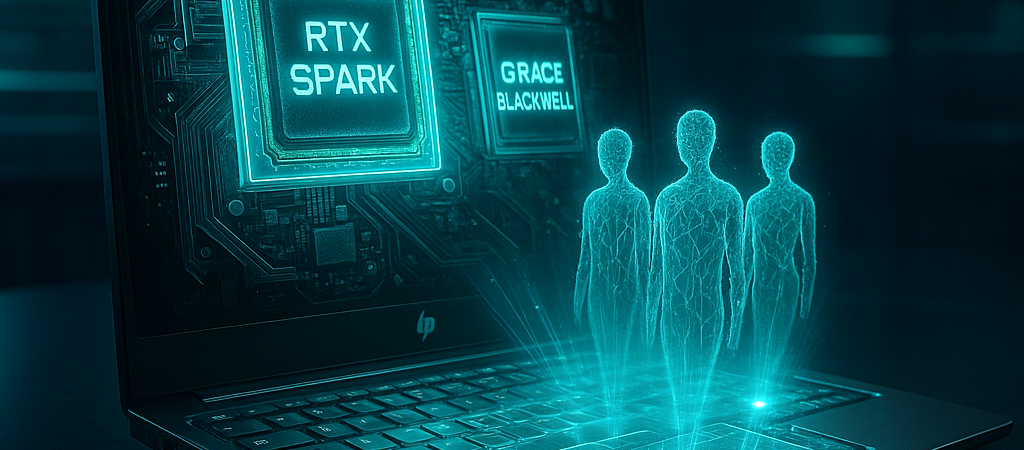
The era of the “AI PC” just stopped being about clever photo editing and started being about local silicon that can think for itself. At Computex 2026, HP pivoted from selling hardware to selling “agentic” ecosystems. By integrating NVIDIA’s RTX Spark and the massive Grace Blackwell GB300 chips into desktop footprints, HP is betting that the future of work isn’t in the cloud—it’s sitting under your desk, disconnected from the internet and running deep-learning agents in real-time.
| Attribute | Details |
| :— | :— |
| Difficulty | Intermediate to Advanced (Developer Focused) |
| Primary Use Case | Local AI Agent Development & Secure Edge Computing |
| Key Hardware | NVIDIA RTX Spark, Grace Blackwell GB300, AMD Ryzen AI PRO 400 |
| Software Stack | NVIDIA Spark Platform, AMD ROCm, Hermes Agent Framework |
The Why: The Death of AI Latency
For the past two years, AI has been a “chat-and-wait” experience. You send a prompt to a server in Oregon, and it sends a response back. For developers building autonomous agents—software that can navigate your file system, write code, and execute tasks—that latency is a dealbreaker.
HP’s new lineup solves the “Data Gravity” problem. By stuffing NVIDIA RTX Spark into the OmniBook Ultra 16 and bringing Blackwell-grade supercomputing to the Windows desktop, HP is removing the umbilical cord to the cloud. This hardware shift is part of a broader industry trend where Microsoft’s strategic pivot toward Local AI is redefining how we interact with edge computing. Developers care because local execution means zero API costs, total data privacy for regulated industries, and the ability to run “agentic” workflows—where the PC anticipates the user’s needs—without a 500ms lag.
Setting Up Your Local Agent Engine
If you’re looking to transition from cloud-based LLMs to the local agentic workflows HP is pitching, here is how you leverage this new stack.
- Audit your VRAM requirements: Before picking an OmniBook X 14 or the larger ZGX series, calculate the parameter count of the models you intend to run. RTX Spark is optimized for “thinner” silhouettes, but if you’re running frontier-level agents, the GB300-powered deskside units are the only way to avoid swapping to system RAM.
- Initialize with OpenClaw: HP is shipping these units with “OpenClaw” starter kits. Instead of manually configuring CUDA environments and Python virtual environments, use the pre-packaged command-line tools to pull optimized weights for models like Llama 3 or Mistral.
- Deploy the Hermes Framework: Shift from simple chatbots to agents. Use the supported Hermes framework to define “tools” for your AI—giving it permission to read local documents or interact with Windows APIs—and run them locally on the Spark platform.
- Harden the Environment: If you are working in a regulated space (finance, defense, or healthcare), utilize the ZGX Nano’s physical interface locks to create a “black box” AI development zone that is physically incapable of leaking data via wireless signals. This level of security is becoming standard as the Pentagon integrates OpenAI’s ChatGPT into GenAI.mil to provide secure generative tools for sensitive operations.
💡 Pro-Tip: Don’t just rely on the NPU for everything. While NPUs are great for battery-sipping background tasks, use the RTX Spark GPU for the initial “pre-fill” stage of LLM inference. It is significantly faster at processing large context windows before the NPU takes over for the token generation.
The Buyer’s Perspective: Silicon Wars at Your Desk
HP is playing a sophisticated game of “Switzerland” by offering high-end builds for Intel, AMD, and NVIDIA simultaneously.
- Against Apple: The MacBook Pro has long been the favorite for local LLM work due to Unified Memory. However, HP’s integration of the NVIDIA GB300 Grace Blackwell Desktop Superchip brings “frontier-level” power to Windows that Apple’s M-series currently can’t match in raw TFLOPS for training and fine-tuning.
- The Mini-PC Meta: The OmniDesk Mini is a direct shot at the Mac Mini, but with a twist: Thunderbolt Share. The ability to control two PCs with one keyboard/mouse while transferring files at 40Gbps makes it a niche but powerful “sidecar” for developers who need a dedicated AI node alongside their main workstation.
- The Security Play: The ZGX Nano is the standout for enterprise. Most AI PCs are “leaky” by design, constantly pinging home for telemetry. The Nano’s “Zero Trust” hardware restriction is a rare example of a manufacturer acknowledging that the most valuable AI work often needs to happen in a Faraday cage. Indeed, securing the future of AI agents is now as much about the hardware environment as it is about the software.
FAQ
Q: What exactly is NVIDIA RTX Spark?
A: It is NVIDIA’s full-stack AI platform designed for thin-and-light Windows laptops. It combines high-efficiency tensor cores with a software suite that allows generative AI to run locally without draining the battery in two hours.
Q: Do I need a Z-class workstation to run AI agents?
A: No. HP is bringing AMD Ryzen AI PRO 400 series to the Z2 Mini, specifically targeting “everyday” developers. You can run smaller, quantized models (like 7B or 8B parameter models) on these off-the-shelf units quite comfortably.
Q: Is “Agentic AI” just a marketing buzzword?
A: Mostly, for now. While the hardware is ready, the software ecosystems (like Hermes and OpenClaw) are still in the early stages. The hardware allows the PC to act as an assistant rather than just a digital typewriter, but the software layer still requires significant developer configuration.
Ethical Note/Limitation: While these PCs can run advanced AI locally, they cannot bypass the inherent biases or “hallucinations” present in the underlying open-source models you choose to install.