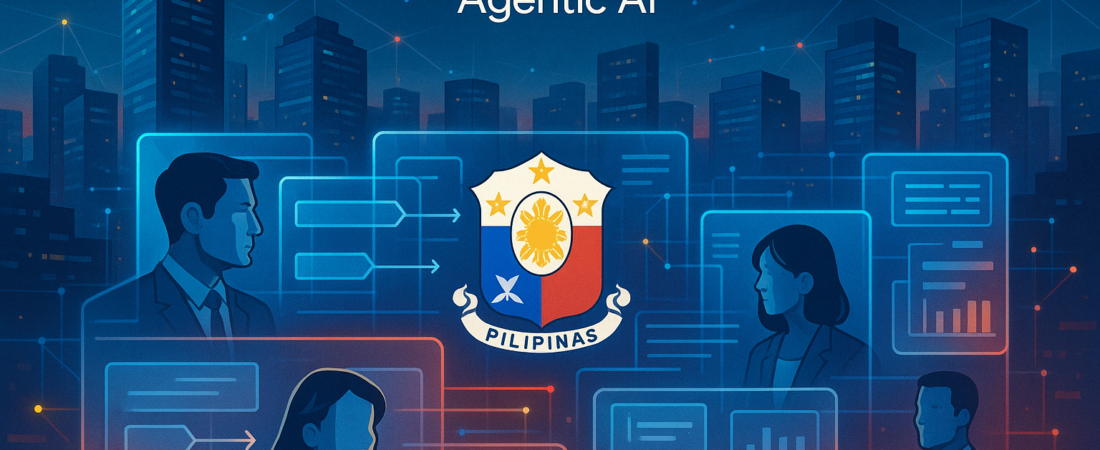
The Philippines is no longer just talking about digital transformation; they’re building it into the national OS. In a massive deal with Google Cloud, the Department of Information and Communications Technology (DICT) is deploying “agentic AI” across the entire government infrastructure. We’re moving past simple chatbots and entering an era where 50,000 public servants—and eventually 200,000—will use AI agents to automate everything from business permits to disaster relief. This isn’t a pilot program; it’s a systemic overhaul.
| Attribute | Details |
| :— | :— |
| Status | Active Rollout (Phase 1: 50,000 Officers) |
| Strategy | Agentic AI Integration & Cyber Defense |
| Tools Needed | Google Gemini Enterprise, Google Workspace, Cybershield |
| Infrastructure | TPU Subsea Cable & eMarketplace |
The Why: Government Interoperability is the Final Frontier
For decades, the “citizen experience” has been defined by silos. Applying for a permit meant dealing with Agency A, while getting health records involved Agency B—none of whom talked to each other.
The DICT’s move to AI agents solves the “interoperability” nightmare. Instead of a citizen navigating a maze of websites, they can use natural language (in local Filipino dialects) to trigger actions across multiple departments. By giving public officers Gemini-powered tools, the government is essentially giving every desk clerk a supercharged research assistant, slashing the time it takes to “retrieve and synthesize” data from weeks to seconds. This mirrors similar efforts in the United States, such as when New York launched the nation’s largest state-level AI rollout, equipping 100,000 employees with similar Google Gemini-powered tools to modernize public service.
The Playbook: How the DICT is Scaling AI Agents
The Philippines isn’t just buying licenses; they are building a recursive ecosystem where hardware, software, and security feed into each other. Here is how they are doing it:
- Procure Through Centralized Markets: The DICT uses the “eMarketplace” (built on Google Cloud) to allow various agencies to acquire Gemini Enterprise tools seamlessly. This prevents “shadow IT” and ensures every department uses the same governed environment.
- Deploy “Front Door” Interfaces: They are rolling out the Gemini Enterprise app as the primary UI. A building official can now ask the chat interface to “identify all pending permits in Barangay Central from last month,” and the AI pulls that data from disparate sources instantly.
- Bridge the Tech Gap with Connectors: To avoid being locked into one ecosystem, the DICT uses built-in connectors to link Google’s AI outputs with third-party apps like Microsoft 365. This ensures the AI agent can “read” a document whether it’s in a Google Doc or an Excel sheet.
- Harden the Perimeter via AI-Powered Defense: You can’t build an AI-driven government on a weak foundation. The Cybersecurity Bureau is onboarding 90 agencies into a “Cyberhield” alliance to fight AI-powered threats with AI-powered defenses.
- Upgrade the Physical Backbone: AI is data-hungry. The DICT is extending the Taiwan-Philippines-US (TPU) subsea cable to handle the massive bandwidth required for these agents to run without latency.
💡 Pro-Tip: For organizations looking to replicate this, focus on Vertex AI extensions. The real power of an AI agent isn’t its ability to write text; it’s its ability to “call” an API or a database through a connector. Much like how Deloitte uses Google Cloud’s agentic AI to transform databases into action engines, the goal is to execute complex enterprise workflows rather than just answering questions.
The Buyer’s Perspective: Google vs. The Field
The DICT’s choice of Google Cloud over competitors like Azure or AWS likely came down to two factors: Local Language Support and Workspace Integration. While Microsoft has a strong grip on enterprise office software, Google’s Gemini has shown aggressive progress in processing regional dialects and “zero-latency” search-to-action workflows. We are seeing a massive shift in the market as Google replaces Vertex AI with the Gemini Enterprise Agent Platform, allowing for persistent memory and identity within a governed environment.
Furthermore, Google’s willingness to fund physical infrastructure (the TPU subsea cable) makes them a “full-stack” partner for a developing nation. However, the risk remains in “vendor lock-in.” By weaving Gemini so deeply into the e-procurement and digital ID systems, the Philippines is betting its entire digital future on one provider’s roadmap.
FAQ
Can citizens use this now?
Not yet for direct interaction. The current phase focuses on 50,000 public officers. Citizen-facing integration—like voice-activated local language services—is expected to follow as the eGovernment superapp scales.
What happens to government jobs?
The DICT’s strategy focuses on “systemic efficiency.” The goal isn’t to replace officers but to eliminate the manual “search and retrieve” tasks that cause the 3-month backlogs common in public service. This approach is becoming a standard; for example, Massachusetts recently launched a first-of-its-kind ChatGPT rollout for 40,000 state employees specifically to boost government efficiency.
How is the data kept secure?
All AI activity occurs within a “fully governed environment.” By using Gemini Enterprise rather than the public version of Gemini, data stays within the government’s controlled cloud to prevent leaks.
Ethical Note: While these AI agents can synthesize data with incredible speed, they cannot verify the physical truth of a document—human oversight is still required to prevent “hallucinated” approvals or fraudulent permit processing. To mitigate these risks, agencies are looking toward safety protocols for AI agents to prevent unauthorized actions and manage autonomous risks.