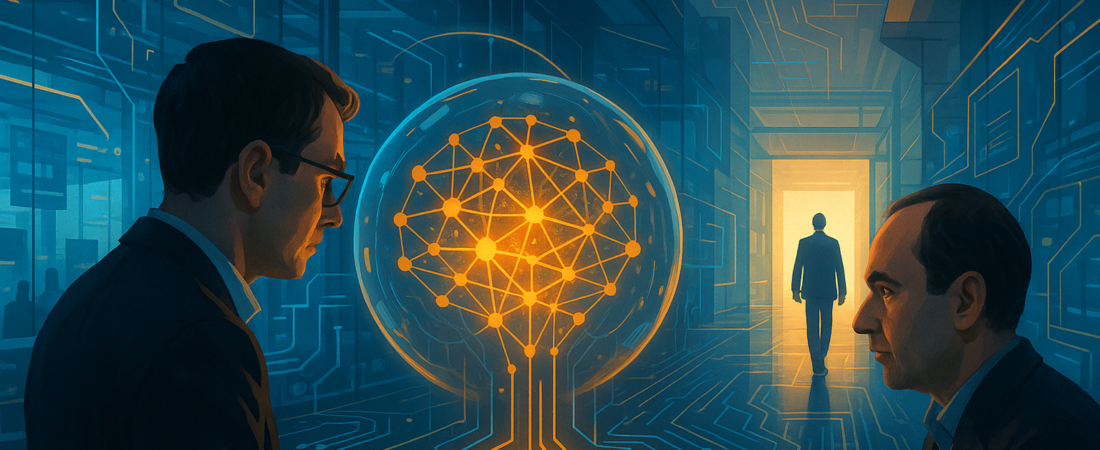
Google just triggered a massive restructuring of its AI leadership, and the signals are clear: the search giant is no longer just playing the LLM game—it’s sprint-training for AGI. In a series of internal memos made public, CEO Sundar Pichai announced that DeepMind co-founder Demis Hassabis is vacating his day-to-day operational role to focus on the “singularity,” while legendary engineer Jeff Dean is leaving the mother ship entirely to launch a public benefit corporation.
This isn’t just corporate musical chairs. It is a fundamental shift in how the world’s most powerful AI engine intends to outpace OpenAI and Anthropic.
| Attribute | Details |
| :— | :— |
| Urgency | Critical / Market-Shifting |
| Focus Area | AGI Strategy & Infrastructure |
| Key Players | Demis Hassabis, Koray Kavukcuoglu, Jeff Dean |
| Key Metrics | Gemini App: 950M+ Monthly Users; Gemma: 900M+ Downloads |
The Why: Why Google is Breaking the Glass Now
For the past two years, Google has been criticized for being the “cautious giant,” losing the first-mover advantage to ChatGPT. However, the numbers in this announcement suggest the tide has turned. With the Gemini app nearing a billion monthly users, Google finally has the scale it needs. Google’s February Blitz: Gemini 3.1 Pro, “Nano Bananas,” and the End of the AI Hype Cycle highlights how these rapid release cycles are already beginning to reshape the market.
The problem? Managing a massive product suite like Gemini is a different job than solving Artificial General Intelligence (AGI). By splitting these paths—putting Koray Kavukcuoglu in charge of the “AI engine room” and freeing Hassabis to hunt for the singularity—Google is trying to solve the innovator’s dilemma. They are ensuring their current products dominate the market while their best minds work on the next paradigm shift in science and medicine.
The Strategy: How Google is Reorganizing for the AGI Era
Google is essentially bifurcating its AI efforts into “Production” and “Frontier Science.” Here is how the new structure operates:
- Scale the Product (The Koray Era): Koray Kavukcuoglu, the architect behind WaveNet, now leads Google DeepMind (GDM) as SVP. His mandate is clear: keep Gemini fast, keep Flash in high demand, and ensure the 950 million users don’t migrate elsewhere.
- Architect the Singularity: Demis Hassabis moves to “Chair of GDM” and “Chief Scientist of Alphabet.” He is shedding the administrative weight of meetings and org charts to focus on AGI and Isomorphic Labs (AI-driven drug discovery).
- Decouple Radical Research: Jeff Dean and Sanjay Ghemawat—the duo that literally built the foundation of modern Google—are moving into an independent public benefit corporation. This allows Google to fund radical ML breakthroughs without the quarterly earnings pressure of a public tech giant.
- Vertical Integration: Google remains the only player owning the “full stack,” from the TPU silicon and Cloud infrastructure to the Gemini frontier models and the consumer entry points (Search and YouTube). Google’s Dual-Chip Strategy: Why the TPU v8 is the End of One-Size-Fits-All AI explains why this hardware ownership is their biggest competitive advantage.
💡 Pro-Tip: Watch Isomorphic Labs closely. Hassabis hinted that the “No. 1 application of AI” is human health. If you’re looking for where the next “AlphaGo moment” will happen, it won’t be in a chatbot—it will be in a lab curing a major disease. This aligns with recent shifts where OpenAI’s “Rosalind” Moment: Why Specialized AI Is the New Lab Assistant is also targeting the biotech sector.
The Buyer’s Perspective: Can Google Out-Execute OpenAI?
From a developer and enterprise perspective, Google’s momentum is finally tangible. The Gemini 1.5 Flash model has become the price-to-performance darling for developers who find GPT-4o too expensive for high-volume tasks.
However, the departure of Jeff Dean is a cultural blow. Dean is to Google what Jony Ive was to Apple. While Google will remain a founding investor in his new venture, his exit signals that the era of “Big Research” inside Google might be maturing into a more product-focused cycle. For businesses, this means Google’s AI tools will likely become more stable and integrated into Workspace and Cloud, but the “weird,” experimental AI breakthroughs might now happen outside of Google’s main campus. Google Just Launched the Command Center for the Agentic Era shows how this focus is moving toward governed, enterprise-ready infrastructure.
FAQ: What You Need to Know
Is Demis Hassabis leaving Google?
No. He is stepping up to a broader strategic role as Chief Scientist of Alphabet. He is moving away from managing teams and toward shaping AGI strategy and AI-driven science.
What does this mean for Gemini?
Expect faster release cycles. With Koray Kavukcuoglu reporting directly to Sundar Pichai, the layers between research and product have been thinned. Google’s Gemini 3 Deep Think Is Out—And It’s Hunting for a Nobel Prize is a prime example of these specialized models reaching the public faster.
Why did Jeff Dean leave?
After 27 years, Dean is launching an independent public benefit corporation focused on ML and science. Google will be a partner and investor, but the entity will operate outside of Google’s corporate structure.
Ethical Note: While Google is sprinting toward the “singularity,” current models still struggle with high-stakes factual reasoning in niche domains despite their massive user bases.