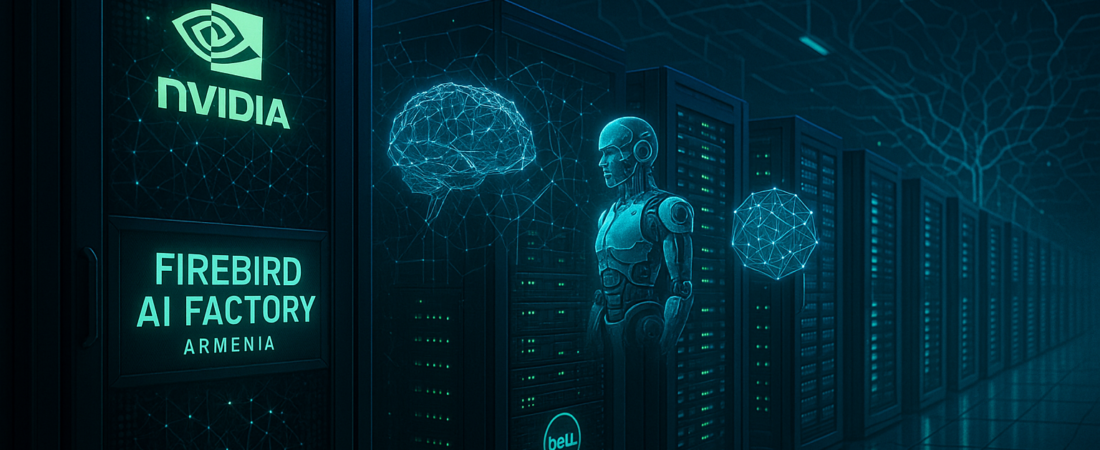
Armenia just signaled it’s no longer content being a regional tech hub; it wants to be the engine room of the CIS AI economy.
Today’s announcement by Firebird AI regarding the launch of the region’s largest “AI Factory” isn’t just a local win—it’s a massive infrastructure play backed by the heavy hitters of Silicon Valley. With NVIDIA, Dell, Schneider Electric, and Vertiv providing the backbone, this facility is designed to turn Yerevan into a high-octane processing center for generative AI and robotics.
While the world focuses on software, Armenia is betting on the raw, unadulterated computing power required to run it. This move aligns with a broader Indian AI surge, where emerging economies are no longer just “catching up” but are becoming global laboratories for high-utility localized solutions.
At a Glance: The Firebird AI Factory
| Attribute | Details |
| :— | :— |
| Strategic Importance | Largest AI infrastructure in the CIS region |
| Key Partners | NVIDIA, Dell, Schneider Electric, Vertiv |
| Primary Focus | GenAI, Robotics, Enterprise Scaling |
| Target Users | Developers, Universities, Public Institutions |
| Hardware Pedigree | NVIDIA Accelerated Computing (Blackwell/Rubin ready) |
The Why: Beyond the Hype of “Tech Hubs”
For years, the CIS (Commonwealth of Independent States) region has struggled with a “compute gap.” Local startups had the talent but lacked the local infrastructure to train large-scale models without relying on latent-heavy, expensive cloud instances from Western Europe or the US.
Firebird AI’s new facility solves three immediate bottlenecks:
- Sovereignty: Providing local institutions the ability to process sensitive data without it leaving the region.
- Cost: Localized AI factories reduce the “transit tax” of global cloud providers.
- Scale: By leveraging NVIDIA’s latest Blackwell-ready architecture, the facility allows for the training of complex robotic systems and large language models (LLMs) that were previously impossible to handle on regional hardware. This specialized hardware is a direct answer to the ASIC inference cloud, which aims to reduce costs and latency for autonomous agents compared to traditional GPU setups.
How to Leverage Regional AI Infrastructure
If you are a developer or an enterprise leader looking to tap into this new regional powerhouse, follow this roadmap to integration.
- Audit Your Compute Needs: Determine if your current cloud costs are driven by data egress or high GPU hourly rates. If you are training models specifically for regional markets (local languages or logistics), moving workloads to a localized “factory” can slash latency.
- Access the NVIDIA Ecosystem: Since the factory is built on NVIDIA accelerated computing, ensure your stack is optimized for CUDA. Use NVIDIA’s NeMo framework for generative AI or Isaac for robotics to ensure seamless deployment on Firebird’s hardware.
- Apply for Institutional Access: If you are a university or public researcher, Firebird has indicated a priority for “local development opportunities.” Reach out to their partnership arm to secure subsidized compute credits.
- Deploy via Hybrid Cloud: Don’t move everything at once. Use the Armenian facility for high-intensity training phases while keeping your inference (user-facing) nodes distributed globally.
💡 Pro-Tip: When negotiating compute time in new regional factories, ask for “spot instance” pricing during off-peak hours (nighttime in Yerevan). Because these facilities have high fixed cooling costs, they often offer steep discounts to keep the hardware running at capacity 24/7.
The “Buyer’s Perspective”: Is Firebird AI the Real Deal?
In the global landscape, Firebird AI is competing against giants like AWS and Azure. However, they aren’t trying to beat them on sheer size; they are beating them on localization.
By partnering with Dell and Schneider Electric, Firebird isn’t just buying chips; they are building a redundant, high-efficiency environment. The inclusion of Vertiv suggests a heavy focus on liquid cooling and power management—essential for the next generation of power-hungry NVIDIA chips. This infrastructure is a critical component of what experts are now calling Spacelift Intelligence, the orchestration layer needed to bridge the gap between developer velocity and infrastructure stability.
The Upside: For companies operating in Eastern Europe and Central Asia, this is the lowest latency you will find.
The Downside: Success depends on political stability and the ability to maintain a steady pipeline of high-end hardware despite global supply chain fluctuations.
The Ethical Friction: A Necessary Reality Check
As one savvy commenter, Abby Jo, pointed out on the announcement: “NVIDIA gets paid when the race accelerates.”
There is a valid concern here. As we build “AI Factories” across the globe, we must ask if we are building the social and regulatory brakes to match. An AI factory in Armenia brings economic growth, but it also brings massive energy demands and the risk of automating local labor before the social safety nets are ready. We are building the engine; we haven’t quite mastered the steering wheel yet. This highlights the growing need for a robust Federal AI Framework to manage these rapid transitions safely and accountably.
FAQ: What You Need to Know
1. Is this just a data center?
No. A “data center” stores data; an “AI Factory” is a specialized facility optimized for processing data into intelligence. It uses high-bandwidth interconnects (like InfiniBand) that standard data centers lack.
2. Can international startups use the Firebird facility?
Yes. While the press release emphasizes regional growth, these facilities typically operate on a commercial basis, welcoming global demand to offset the massive capital expenditure of the hardware.
3. Why Armenia?
Armenia has a high density of engineers per capita and a government aggressively courting tech investment to diversify its economy. It serves as a neutral, high-tech bridge between various global markets.
Ethical Note: While this facility boosts regional GDP, it cannot currently solve the “black box” problem of AI transparency or the environmental impact of high-density compute clusters.