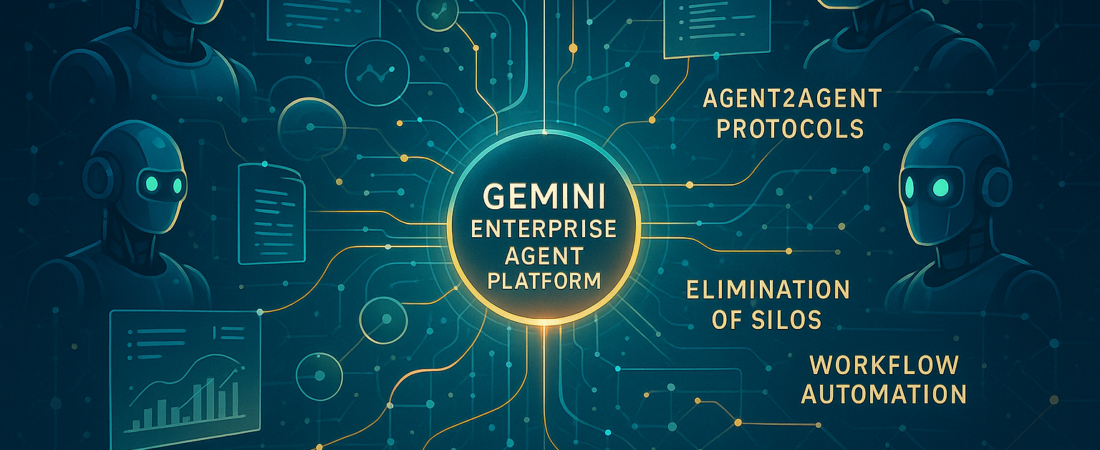
The era of the “lonely chatbot” is over. While most companies are still struggling to get a single AI to summarize a meeting without hallucinating, Google Cloud has quietly shifted the goalposts. Alex Rutter recently broke down the Gemini Enterprise Agent Platform, and it’s not just another tool—it’s an operating system for an entire workforce of AI agents that actually talk to each other.
For the enterprise, this is the end of “siloed AI.” We’re moving from tools that answer questions to ecosystems that execute multi-step workflows across your entire tech stack.
Quick Overview: Gemini Enterprise Agent Platform
| Attribute | Details |
| :— | :— |
| Difficulty | Intermediate (Requires Cloud Architecture knowledge) |
| Time Required | 30–60 minutes for initial environment setup |
| Tools Needed | Google Cloud Console, Gemini Enterprise, Vertex AI, BigQuery |
| Key Focus | Multi-agent orchestration and “Agent2Agent” protocols |
The Why: The Death of the AI Silo
Most businesses have a “bot problem.” They have a bot for HR, a bot for customer service, and a bot for data analysis. The issue? None of them share notes. When a customer asks for a refund based on a complex shipping error hidden in a SQL database, the customer service bot hits a wall.
The Gemini Enterprise Agent Platform solves this by introducing an orchestration layer. Instead of you acting as the middleman between different AI tools, Google’s new framework allows agents to hand off tasks to one another seamlessly. It transforms AI from a passive consultant into an active participant in your business logic. This shift represents a broader movement toward agentic computing, where devices and platforms are expected to complete tasks rather than just provide information.
How to Build Your Multi-Agent Ecosystem
If you want to move past basic prompts and start building a functional agentic workflow, follow this roadmap.
1. Define Your “Primary” Orchestrator
Start by identifying your lead agent. In the Gemini ecosystem, this is the “Manager” agent that understands the user’s intent and decides which specialist agents need to be called in. You’ll use the Agent Development Kit (ADK) to define these roles. This architecture is central to the Gemini Enterprise Agent Platform, which aims to solve agent sprawl through governed autonomous workflows.
2. Connect Your Data via Managed MCP
Don’t let your agents fly blind. Use the newly announced Managed MCP (Model Context Protocol) Servers for databases. This allows your agents to securely read and write to your existing PostgreSQL or BigQuery instances without you having to write thousands of lines of “glue code.” You can learn more about how to bridge the gap between local dev tools and Google Cloud using these remote MCP servers.
3. Implement the Agent2Agent Protocol
This is the secret sauce. By using the Agent2Agent protocol, you allow a “Sales Agent” to automatically trigger a “Logistics Agent” when a purchase is confirmed. Define the hand-off triggers clearly so the context—what the customer said, their history, and the specific SKU—isn’t lost during the transition.
4. Ground Everything in Truth
Use Vertex AI’s grounding capabilities to link your agents to first-party data. This prevents the “creative” hallucinations that plague consumer-grade AI. If the data isn’t in your BigQuery or linked documentation, the agent shouldn’t make it up. Integrating a single source of truth is the most effective way to stop AI hallucinations in enterprise environments.
5. Monitor via Conversational Analytics
Once live, don’t just “set it and forget it.” Use the Conversational Analytics in BigQuery (currently in preview) to analyze how agents are interacting. Look for “dead ends” where one agent fails to pass the baton to the next.
💡 Pro-Tip: The Tokenomics Hack
To keep costs down, don’t use your most powerful model (Gemini 1.5 Pro) for every sub-task. Use the Agent Harness to route simple data-formatting tasks to Gemini Flash, and save the “Pro” model for high-level reasoning and final decision-making. This can cut your operational costs by up to 60% without sacrificing quality. Understanding what is an agent harness is becoming a critical skill for product teams looking to build predictable infrastructure.
The Buyer’s Perspective: Google vs. The World
Google isn’t the only player in the agentic space—Microsoft has Copilot Studio and OpenAI is pushing “Swarm.” However, Google’s advantage lies in its data integration.
While Microsoft is great if you live entirely in Excel and Outlook, Google’s platform is built for the developer who needs to bridge the gap between a custom order management system (like URBN’s migration to AlloyDB) and a customer-facing app. Many organizations are now choosing to deploy AI agents with persistent memory and identity to move away from legacy Vertex AI implementations. The Gemini Enterprise Platform feels less like a “feature” and more like a robust infrastructure play. It’s built for scale, but it requires a higher level of technical maturity than the “plug-and-play” competitors.
FAQ
Q: Do I need to migrate all my data to Google Cloud to use this?
A: Not necessarily. Through Managed MCP servers and API connectors, Gemini agents can interact with data residing in other environments, though latency and security are best managed within the Google Cloud ecosystem.
Q: Is “Multi-Agent” just marketing speak for a complex chatbot?
A: No. A chatbot is a single loop. Multi-agent orchestration involves autonomous hand-offs, where one AI creates a script, another reviews it for brand compliance, and a third schedules it—all without a human clicking “next.”
Q: How does this handle security?
A: Gemini Enterprise uses “First-party AI stacks,” meaning your data isn’t used to train the global model. You maintain the “sovereignty” of your business logic and customer data within your specific tenant. Furthermore, Google has released an AI Control Roadmap to establish safety protocols that prevent unauthorized actions by autonomous agents.
The Reality Check
While multi-agent systems are powerful, they are not autonomous “employees” yet. They still require rigorous guardrails and human-in-the-loop oversight for high-stakes decisions like financial approvals or medical advice.