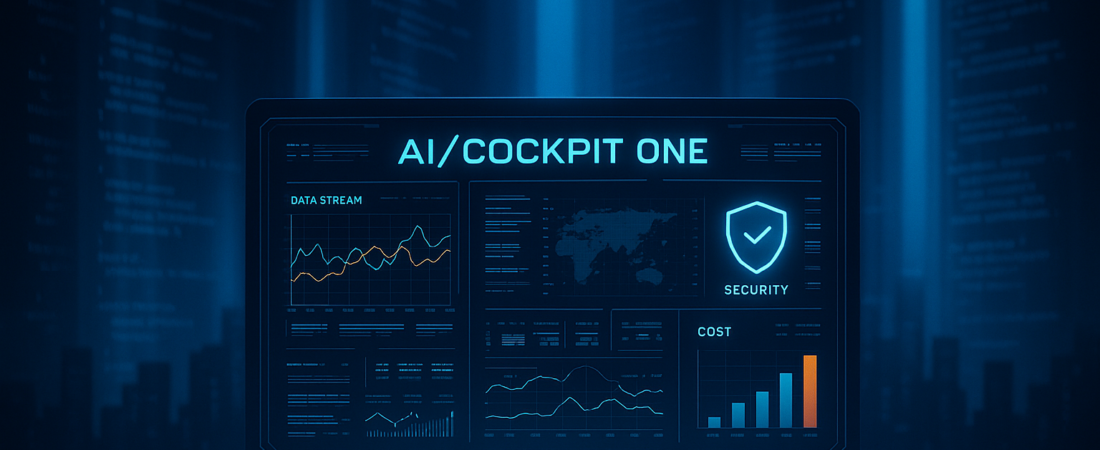
Enterprises aren’t suffering from a lack of AI; they’re suffering from a lack of control. As teams DIY their way through Langflow, n8n, and custom Python scripts, the average CTO is left staring at a fragmented mess of security holes and unmonitored API costs. AI/R’s launch of AI/Cockpit One marks the moment we stop playing with AI toys and start building industrial machinery. By centralizing access, observability, and governance into a single pane of glass, it aims to turn the “Wild West” of corporate AI into a governed, scalable ecosystem.
| Attribute | Details |
| :— | :— |
| Difficulty | Intermediate (Requires familiarity with API orchestration) |
| Time Required | 30–45 minutes for initial module connection |
| Tools Needed | AI/Cockpit One, Langflow/n8n/Flowise, Enterprise API Keys |
The Why: The High Cost of “Shadow AI”
Right now, most companies have a visibility problem. Developers are building powerful agents using third-party platforms like Flowise or n8n, but these often sit outside the corporate security perimeter. This creates “Shadow AI”—tools that process company data without identity management or cost controls. For organizations struggling to maintain oversight, implementing a robust AI governance framework is no longer optional; it is a requirement for operational stability.
AI/Cockpit One solves the “fragmentation tax.” It acts as the central nervous system for an organization’s AI operations. You care about this because it finally bridges the gap between the agility of open-source orchestration (like Langflow) and the rigid security requirements of a Fortune 500 company. It’s the difference between a cool demo and a deployable product.
Step-by-Step Instructions: Governing Your AI Stack
To move from fragmented tools to a unified cockpit, follow this blueprint:
- Audit Your Endpoints: Catalog every instance of Langflow, n8n, or Flowise currently running across your departments. You can’t govern what you can’t see.
- Map Identity and Access (IAM): Connect your corporate identity provider (like Okta or Azure AD) to Cockpit One. This ensures that only authorized personnel can trigger specific agentic workflows.
- Integrate Third-Party Modules: Use the Cockpit One interface to “plug in” your existing third-party platforms. The system uses a unified connector framework to pull logs and performance data from these disparate sources.
- Define Your Reliability Dimensions: AI/R breaks reliability into four specific dimensions. Configure your monitors to alert you when an agent fails to meet thresholds in accuracy, latency, cost, or safety. To prevent catastrophic errors, ensure your team understands how to implement an Agentic Kill Switch as a final safety layer.
- Deploy and Observe: Launch your agents through the Cockpit. Instead of checking five different dashboards, monitor your entire fleet’s token spend and success rates from the central hub.
💡 Pro-Tip: Use Cockpit One’s observability layer to identify “zombie agents”—automated workflows that are consuming tokens but haven’t successfully completed a task in over 48 hours. Shutting these down can slash your monthly API overhead by up to 20%.
The Buyer’s Perspective: A Unified Layer vs. The Silo approach
In the current market, you usually have two choices: go “all-in” on a closed ecosystem (like Microsoft Copilot) or build a custom dashboard from scratch.
AI/Cockpit One takes a third path: The Aggregator.
Compared to competitors who try to lock you into their own LLMs, AI/R is betting on the fact that enterprises will always use a mix of tools. The value proposition here isn’t the AI itself, but the governance of it. If you are heavily invested in open-source tools like n8n but need to satisfy a CISO who is worried about data leakage, this platform is specifically built for your headache. However, be aware: the complexity of managing a “unified” layer means your team still needs to understand the underlying logic of the tools you’re connecting. This is particularly important for securing autonomous AI agents against external threats and prompt injections. It simplifies the view, not the technology.
FAQ
Does AI/Cockpit One replace tools like Langflow or n8n?
No. It acts as an umbrella. You still use Langflow to build the logic, but you use Cockpit One to manage who uses it, how much it costs, and whether it’s behaving safely.
How does it handle data privacy?
It provides a unified identity layer. Instead of every tool having its own login, everything flows through your enterprise-grade security protocols, keeping data access restricted to the “need-to-know” level. Organizations concerned about internal leaks should look into ESET AI security to monitor for prompt leakage and sensitive data loss.
Can I monitor costs across different LLM providers?
Yes. One of the primary features is centralized cost control, allowing you to see token spend across OpenAI, Anthropic, and local models in one place.
Ethical Note/Limitation: While AI/Cockpit One provides the tools for governance, it cannot automatically fix a fundamentally biased or poorly programmed underlying AI model.