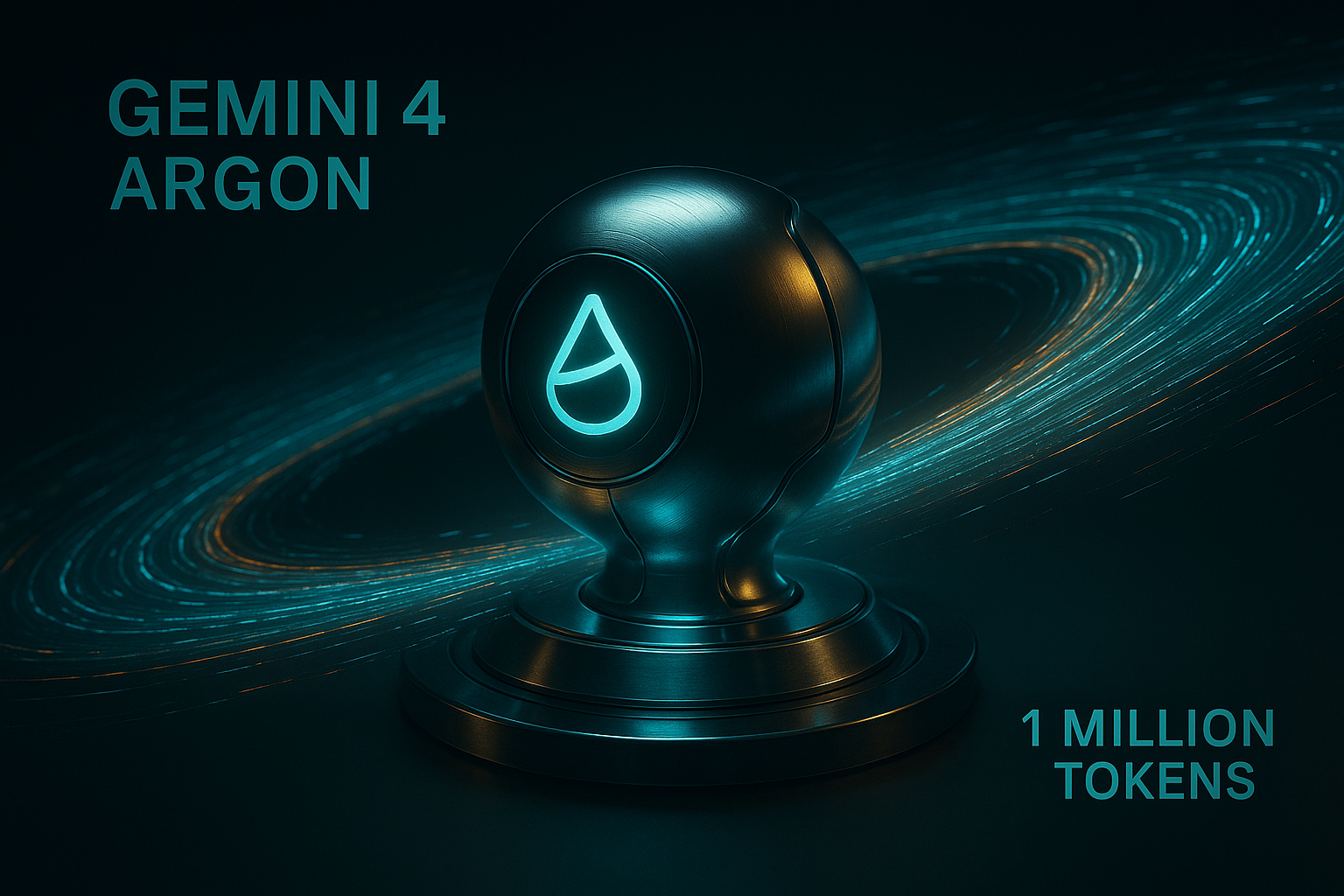
Google just signaled that the “vibes” era of generative AI is over. While the public is still wrestling with Gemini 1.5’s quirks, Mountain View has quietly deployed Gemini 4 Argon internally—and the early numbers suggest Google is finally prioritizing raw economic utility over flashy chatbot demos.
The headline? Argon isn’t just smarter; it’s vastly more efficient. Google claims the model’s autonomous agents have already identified memory optimizations in its own data centers that will claw back over 300 TiB of storage. In an industry where “compute” is the new oil, finding that much “lost” capacity is the equivalent of discovering a new well in your own backyard.
Quick Stats: Gemini 4 Argon At a Glance
| Attribute | Details |
| :— | :— |
| Status | Internal Beta (Google Employees Only) |
| Context Window | 1 Million Tokens (Output Limit) |
| Benchmark Leader | #1 on Vals Index (Economic Impact) |
| Core Strength | Multi-step Financial & Technical Reasoning |
| Primary Goal | Operational Efficiency & Resource Optimization |
The Why: Moving from “Cool” to “Profitable”
For the past year, Google has been playing defense. OpenAI and Anthropic grabbed the cultural zeitgeist, while Google scrambled to integrate AI into Workspace with mixed results. Users complained about “hallucinations” and a lack of practical depth.
Argon is the pivot. By focusing on the Vals Index—a benchmark that weights AI performance based on its contribution to specific sectors of the U.S. GDP (finance, legal, tax)—Google is attempting to prove that AI can do more than summarize emails. They want to prove it can run a hedge fund’s research desk or optimize global infrastructure. If you’re a professional in a high-stakes industry, Argon is the first model designed specifically to impact your bottom line rather than just your “productivity.” This shift follows a broader trend where specialized AI agents are being audited and integrated for niche, high-value tasks rather than general conversation.
How to Prepare for the Argon Era
While the model remains behind Google’s firewall, the shift in architecture—specifically the move to a 1-million-token output limit—changes how we need to build AI workflows. Here is how to prepare your data and prompts for this next-gen scale.
- Audit Your Long-Form Data: Argon’s massive output limit means it can generate entire software modules or 200-page financial reports in one go. Start organizing your internal documentation now. The bottleneck will no longer be what the AI can produce, but the quality of the “grounding” data you provide. To avoid errors at this scale, many enterprises are turning to an AI Knowledge Hub to ensure their models are rooted in truth.
- Transition to Multi-Step Agentic Workflows: Argon excels at “Vals Finance Agent v2” tests. This means it handles chains of logic better than single-shot prompts. Practice breaking your complex business problems into modular sub-tasks.
- Focus on Economic Weighting: When Argon hits the public API, don’t just ask it to “write a report.” Ask it to “write a report optimized for [Legal/Tax/Finance] compliance,” as the model is literally trained to recognize the nuances of these GDP-heavy sectors.
- Monitor the Google Cloud Console: Expect Argon to debut for Vertex AI enterprise customers first. Ensure your Google Cloud environment is set up with the necessary permissions for “Experimental Models” to get early access. This is a significant step in Google’s February AI updates, marking a transition toward high-reasoning models.
💡 Pro-Tip: The 1-million-token output limit is a game-changer for coding. Unlike current models that give you snippets, Argon can theoretically rewrite an entire legacy codebase in one session. To save on costs when it launches, use “System Instructions” to strictly define the scope of the output, or you’ll burn through your token budget on unnecessarily verbose technical manuals.
The “Buyer’s Perspective”: Google vs. The World
For a long time, GPT-4 was the undisputed king of reasoning, while Claude 3 took the crown for “human-like” writing. Google’s Argon is carving out a third niche: The Industrial AI. This development comes as competitors also push boundaries, such as GPT-6 Astra, which focuses on autonomous web navigation and extreme benchmark scores.
If Google’s internal claims hold up, Argon is significantly more capable of handling “dry” but essential tasks—like memory optimization and multi-step financial auditing—than its competitors. While OpenAI is chasing AGI (Artificial General Intelligence), Google seems to be building an AGI (Artificial Gross Income) engine. This strategy is reflected in the Gemini Enterprise Agent Platform, which aims to solve agent sprawl through governed, autonomous workflows.
The downside? Google’s track record with public releases is spotty. We’ve seen “internal” benchmarks before that didn’t translate to the real world. Until third-party developers can pressure-test Argon against the Vals Index, take the “300 TiB savings” stat with a grain of salt.
FAQ
When can I actually use Gemini 4 Argon?
Currently, there is no public release date. It is being used by “thousands of Googlers” internally. Expect a limited developer preview via Vertex AI in late 2024 or early 2025.
What is the Vals Index?
It is a new performance metric that evaluates AI based on its economic value. It weights tasks like legal drafting and tax analysis according to their actual share of the U.S. GDP, moving away from “common sense” or “trivia” benchmarks. This is a critical component of a modern enterprise AI strategy, where value is measured by platform utility rather than just model size.
Does the 1-million-token limit apply to input or output?
Google specifically highlighted the output limit. Most current models can read a lot (input) but only write a few thousand words at a time (output). Argon can potentially write a full-length book or a massive codebase in a single response.
Ethical Note: While Argon excels at optimization, it currently lacks the creative nuance required for high-level strategic empathy or subjective brand storytelling. For those interested in the human side of this technology, explore the skepticism regarding AI in creative writing, where human depth still reigns supreme.