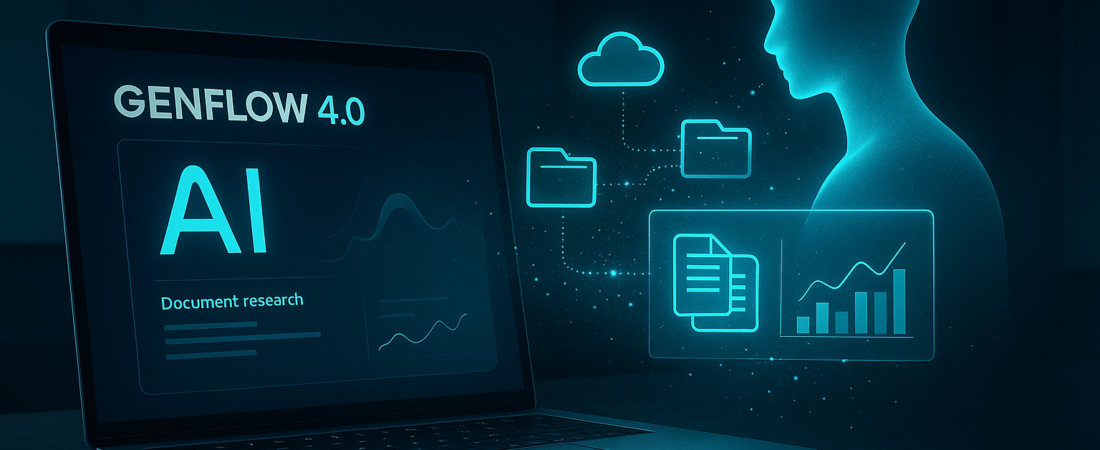
Baidu just stopped trying to build a better chatbot and started building a better coworker. While Western tech giants are busy arguing over LLM benchmarks, Baidu Wenku and Baidu Drive just consolidated their power into GenFlow 4.0—an upgraded AI agent that treats your messy cloud storage as a living, breathing database rather than a digital graveyard.
| Attribute | Details |
| :— | :— |
| Difficulty | Intermediate (Requires ecosystem familiarity) |
| Time Required | 5–10 minutes for setup |
| Tools Needed | Baidu Wenku, Baidu Drive, GenFlow 4.0 Interface |
The Why: Context is the New Gold
The biggest friction point in productivity isn’t writing; it’s finding. We spend hours digging through folders for that one PDF or specific slide deck. GenFlow 4.0 solves this by merging Baidu Wenku’s massive document library (1.2 billion files) with your private Baidu Drive storage.
This isn’t just a search bar. It’s a cross-platform intelligence layer. If you need to draft a market report, the AI doesn’t just hallucinate facts; it pulls from verified documents in Wenku and cross-references them with your own internal notes. It bridges the gap between public knowledge and private data, turning a storage app into an active production studio. This shift toward high-utility tools reflects China’s bold strategy to dominate AI through functional, data-rich ecosystems.
How to Weaponize GenFlow 4.0 for Research
Implementing this workflow requires moving away from the “search and download” mindset. Follow these steps to maximize the agent’s output.
- Sync your silos. Link your Baidu Drive folders to the GenFlow 4.0 workspace. Ensure your proprietary data is categorized so the agent knows which “private” knowledge base to prioritize.
- Define the output format. Instead of asking for a summary, tell GenFlow to “Generate a 10-slide PowerPoint outline based on the last three PDFs I uploaded regarding Q1 earnings.”
- Cross-reference with Wenku. Use the integrated search to pull external industry benchmarks. Command the agent: “Compare my internal sales data with the top three industry reports on Wenku from 2024.”
- Refine via multi-modal inputs. Use voice commands or image uploads (like a photo of a whiteboard) to trigger the agent’s document-creation engine.
- Export and Polish. Move the generated draft directly into Baidu Wenku’s editing suite to finalize formatting without leaving the ecosystem.
💡 Pro-Tip: Use GenFlow’s “Semantic Pivot” feature to find documents you can’t remember the name of. Describe the concept or a specific chart you remember seeing in a file three years ago; the agent scans document metadata and visual elements, not just filenames. Much like how Gemini for Workspace uses agentic workflows to sync Gmail and Drive, GenFlow 4.0 turns your storage into an active participant in your workday.
The Buyer’s Perspective: Baidu vs. The World
Microsoft has Copilot; Google has Gemini in Workspace. So, why does Baidu’s move matter? It comes down to the “Document-First” philosophy.
Microsoft Copilot is an assistant that lives inside Word. GenFlow 4.0, conversely, is an agent that lives inside the storage layer. This is a critical distinction. By placing the AI at the source of the data (Baidu Drive), Baidu reduces latency and improves accuracy. This transition from a simple assistant to a proactive partner is exactly how Microsoft shifts from chatbots to agentic AI with Copilot Coworker, emphasizing the trend toward autonomous digital help.
However, the walled garden is real. If your workflow lives in Google Docs or Notion, GenFlow 4.0 is essentially useless. But for professionals deeply embedded in the Chinese tech ecosystem, this integration offers a level of fluidity that Western users—stuck between jumping from Slack to GPT-4 to Dropbox—should honestly envy. Baidu’s massive proprietary library (Wenku) gives it a “data moat” that general-purpose LLMs lack. It isn’t just smarter; it’s more informed.
FAQ
Does GenFlow 4.0 work with non-Chinese documents?
Yes, it supports multilingual processing, though its primary strength and the vast majority of its reference library (Wenku) are optimized for Simplified Chinese.
Is my private Baidu Drive data safe?
Baidu claims a “strict isolation” protocol where your private files are used to ground your specific AI sessions but are not fed back into the general public training set for Wenku.
Can GenFlow 4.0 create full documents from scratch?
It creates high-fidelity drafts, slide decks, and spreadsheets. However, it functions best as an “assembler” of existing information rather than a creative fiction writer.
Ethical Note/Limitation: While GenFlow 4.0 excels at data synthesis, it cannot independently verify the factual accuracy of the third-party documents hosted on Baidu Wenku, meaning the “garbage in, garbage out” rule still applies.