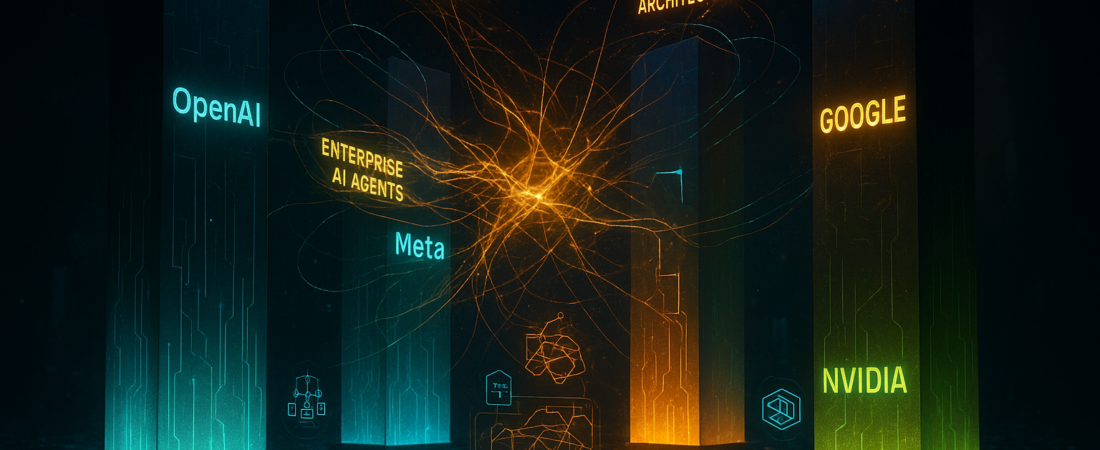
In July 2026, the tech industry hit a fever pitch. Within thirty days, OpenAI, Meta, Google, and the NVIDIA/ServiceNow alliance all launched enterprise AI agent platforms. But if you sit the four products next to each other, you’ll realize they aren’t competing for the same crown—they aren’t even playing the same sport. While the marketing teams all settled on the buzzword “agent,” the engineers built four incompatible theories of how your business should run.
| Attribute | Details |
| :— | :— |
| Difficulty | Advanced (C-Suite & System Architects) |
| Reading Time | 6 Minutes |
| Strategic Focus | Enterprise Governance & Platform Lock-in |
| Key Players | OpenAI, Meta, Google, NVIDIA/ServiceNow |
The Why: The War for the Enterprise Control Point
For two years, the AI conversation was about capabilities—what can the model do? Now, the conversation has shifted to control. Every enterprise wants agents to perform tasks, but no two companies agree on where the “kill switch” or the “steering wheel” should live.
This disagreement is the most important signal a buyer can track. When tech giants scatter like this, it means the industry’s ultimate “control point”—the place where the profit and risk are concentrated—is still up for grabs. If you buy into the wrong philosophy now, you aren’t just buying software; you’re betting your company’s workflow architecture on a vision that might be obsolete by 2028.
Navigating the Split: A Buyer’s Framework
To choose a platform, you must first diagnose your company’s primary bottleneck. You aren’t shopping for features; you are shopping for a solution to your greatest failure mode.
-
Identify Your Failure Mode
- Distribution: Do your agents need to live where your customers are (e.g., WhatsApp)? Look at Meta.
- Containment: Is your biggest fear an agent “hallucinating” its way into a restricted terminal? Look at NVIDIA/ServiceNow’s Project Arc.
- Integration: Do you lack the internal talent to build these systems? OpenAI’s Presence offers “managed accountability” via forward-deployed engineers.
- Data Gravity: Is your data already locked in a specific cloud? Google Gemini Enterprise leverages the proximity of your existing datasets.
-
Audit the “Control Language”
Don’t be fooled by “guardrails.” In 2026, guardrails are the entry fee, not a differentiator. Demand a demonstration of Execution Hooks. Ask the vendor: “Can I stop an agent mid-thought if it tries to access a specific SQL table, and does that audit trail exist outside of your proprietary cloud?” -
Analyze the Commercial “Confession”
Look at the invoice. If the vendor charges per “daily thread” (Meta), they want to own your customer relationship. If they charge for “consulting and integration” (OpenAI), they are a services firm in software clothing. If they charge based on “cloud consumption” (Google), the agent is just a lure to get you to store more data.
💡 Pro-Tip: Don’t build for the “Agent.” Build for the Agent-to-Human Handoff. The most expensive point in any AI deployment isn’t the token cost; it’s the friction created when an agent fails and a human has to reconstruct what went wrong. Prioritize platforms that offer “OpenShell” or transparent logging that humans can read in real-time.
The Buyer’s Perspective: Who Wins the Philosophy War?
We are currently in a “Buzzword Convergence.” Because everyone uses the term “agent,” buyers assume the products are interchangeable. They aren’t.
- Meta Business Agent: This is the “low-friction” winner. It wins because it doesn’t ask businesses to change their habits; it just puts a brain inside the chat apps people already use. Its weakness is “Platform Rent”—you are forever a tenant in Zuckerberg’s house.
- NVIDIA & ServiceNow (Project Arc): This is the “Hard Tech” winner. By building a secured desktop runtime, they solve the security concerns of banks and healthcare. It is the most “sovereign” option, but also the most complex to maintain.
- OpenAI Presence: This is the “White Glove” winner. By refusing to offer self-service and requiring their own engineers to set it up, OpenAI is admitting that enterprise agents are too dangerous to be “Plug-and-Play.” It’s the safest bet for companies with deep pockets and little tech expertise.
- Google Gemini Enterprise: This is the “Incumbent” winner. If you are already on Google Cloud, moving elsewhere for an agent platform introduces “Data Latency.” Google is betting that your laziness—or rather, your efficiency—will keep you in their ecosystem. To manage this at scale, Google replaces Vertex AI to provide governed autonomous workflows.
FAQ
Q: None of these platforms agree on a definition. Which one is the ‘real’ AI agent?
A: None of them. “Agent” is currently a marketing term for “software that can use tools.” The “real” agent will be whichever one your employees actually stop bypassing to get their work done.
Q: Should I wait for the market to consolidate before buying?
A: No. Buy for a two-year horizon. The efficiency gains are too high to ignore, but keep your “exit costs” low. Avoid hard-coding your workflows into a single vendor’s proprietary logic.
Q: Is “governance” just a buzzword?
A: It was in 2024. In 2026, it’s a technical requirement. Platforms like Project Arc that offer “Action Fabric” provide actual software limitations on what code an AI can execute. It’s no longer just a prompt—it’s a physical boundary. To scale safely, teams are looking for agent DLC to move from pilots to production with enterprise-grade security.
Ethical Note/Limitation: Current AI agents still lack “true” causal reasoning; they can follow a script and use a tool, but they cannot yet navigate a systemic crisis that falls outside their training data or pre-defined guardrails.