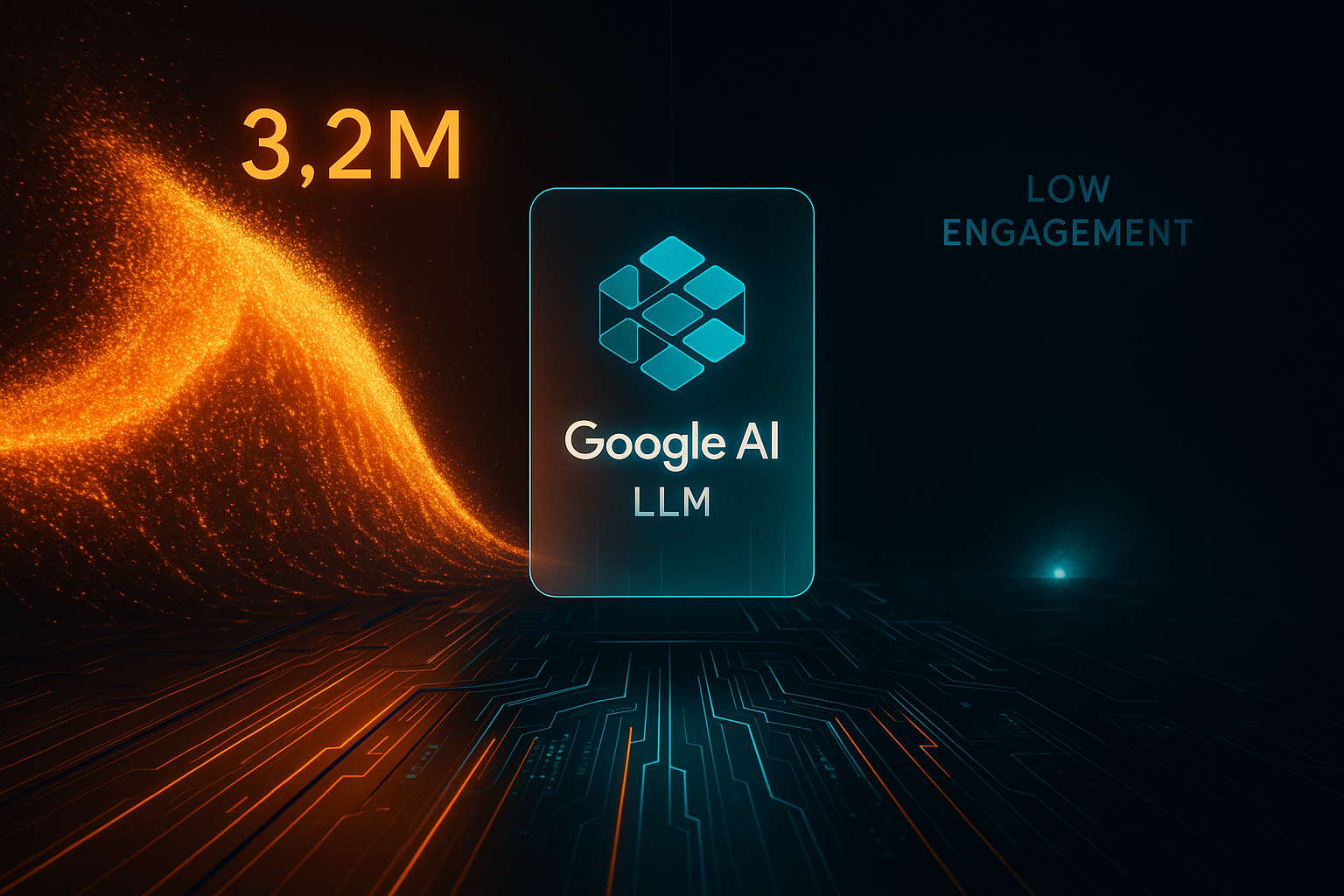
Google DeepMind just dropped Lyria 3, and the numbers are a masterclass in the “reach-resonance gap.” On February 18, 2026, the @GoogleAI account clocked 3.2 million views on a single post—4.6 times the median for a product launch. But beneath the surface of that massive exposure lies a sobering reality: most of those viewers kept right on scrolling.
| Attribute | Details |
| :— | :— |
| Difficulty | Intermediate (Marketing Analytics) |
| Time Required | 5 Minutes |
| Tools Needed | X Analytics, Doomers.ai Database, Lyria 3 |
The Why: The Mirage of Viral Reach
In the current AI arms race, visibility is often mistaken for adoption. Google’s Lyria 3 launch proves that even with 2.5 million followers and a sophisticated music-generation model that turns photos into tracks, raw views are a vanity metric.
The launch achieved “virality without conversion.” It reached 1.3 times Google’s own following, yet the bookmark rate—the gold standard for intent—was a dismal 3.8 per 10,000 views. That’s 70% lower than the median. If you are an AI founder or marketer, this launch is your warning: attention is cheap; retention is expensive. This highlights why world-class AI social media strategies must focus on engagement rather than just broadcasting.
How to Analyze (and Avoid) Empty Virality
- Benchmarking the “Follower Multiple”: Don’t just look at views. Compare reach to follower count. Google stayed “close to home,” hitting only 1.3x their following. Top-tier viral launches typically hit 2.4x or higher. If you aren’t breaking out of your bubble, you aren’t growing.
- Audit the “Save-to-View” Ratio: High views with low bookmarks (like Lyria’s 1K saves vs. 3.2M views) suggest your content is “feed-filler.” People see it, acknowledge it, and forget it.
- Optimize Video Length for the Algorithm, Not the Ego: Google used a 101-second video. Data shows the sweet spot for AI demos is closer to 65 seconds. Every second over a minute acts as a funnel leak.
- Test the “Founder-First” Copy Style: Despite being a corporate behemoth, Google used a first-person opening: “Today we introduced…” This mimics the high-performing “founder” style, which remains the most effective way to frame a launch on X.
- Timing the Market: Google posted on a Wednesday (median 735K views). If they had held for a Friday, they might have tapped into the 879K median view peak, potentially pushing those 3.2M views into the 5M range. To stay ahead of these rapid release cycles, many teams are turning to Google AI updates to track shifts in how reasoning models impact consumer behavior.
💡 Pro-Tip: When launching a creative AI tool, lead with the output, not the tech. The Lyria post focused on the model name. The highest-converting AI launches lead with a 15-second “wow” moment that makes a user stop and ask, “How did they do that?” before they even read the text.
The Buyer’s Perspective: Lyria 3 vs. The Field
Lyria 3 is technically impressive, especially its ability to transform photos into stems. However, Google faces a “friction” problem. While competitors like Udio or Suno focus on instant, frictionless viral sharing, Google’s ecosystem often feels gated or overly corporate. These updates are a key part of the broader Gemini February updates designed to streamline creative workflows.
The data shows a “thin” response. 144 replies for 3 million views is a ghost town. It suggests that while the tech is solid, the community isn’t inspired to build with it yet. If you’re deciding where to put your creative energy, Lyria 3 offers the Google infrastructure, but lacks the grassroots momentum of smaller, more agile music AI startups.
FAQ
Did the Lyria 3 launch fail?
Hardly. It’s in the top 15% of all AI launches tracked. However, it failed to engage its audience, seeing 0.3x the median save rate. It was a massive broadcast, but a quiet conversation.
What is the most important metric for an AI launch on X?
Bookmarks. A bookmark represents a “intent to use.” Lyria’s low bookmark-to-view ratio suggests the audience found the demo interesting but not necessarily useful for their own workflow.
Does video length actually matter?
Yes. The Doomers database shows a clear drop-off after 90 seconds. Google’s 1:41 video likely suffered significant mid-roll churn, contributing to the low engagement-to-view ratio.
Ethical Note/Limitation: While Lyria 3 can generate tracks from images, it currently cannot perfectly replicate specific vocal nuances or complex lyrical structures without significant prompt engineering.