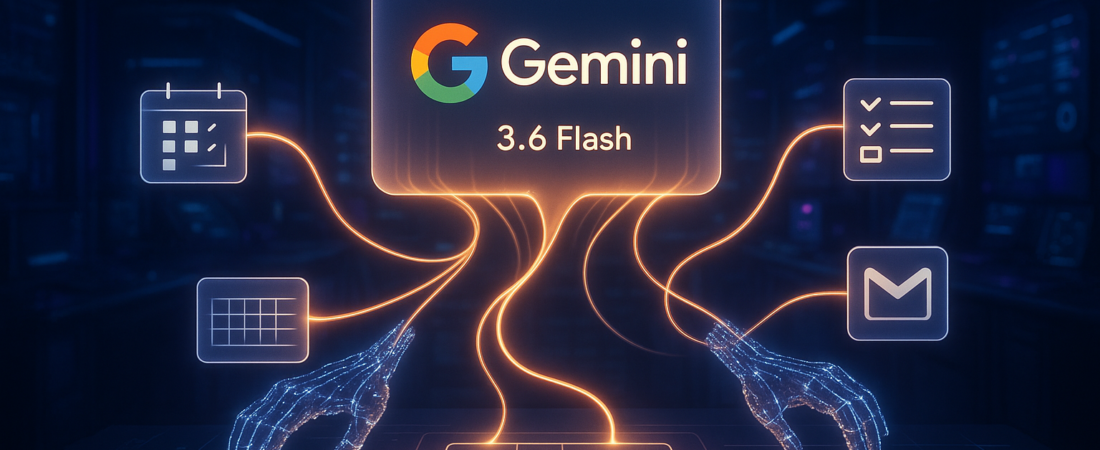
The era of AI as a simple chatbot is over. In July 2026, Google didn’t just release updates; they essentially handed over the keys to “agentic” computing—where AI doesn’t just talk to you, but actually completes the chores you’ve been dreading. From robots that reason in the physical world to “Flash” models designed for massive scale, the gap between digital intent and physical action has vanished.
| Attribute | Details |
| :— | :— |
| Difficulty | Intermediate (Strategic Implementation) |
| Time Required | 15–20 minutes to explore new features |
| Tools Needed | Gemini 3.6/3.5, Google Vids, Android 17, Google Cloud |
The Why: Moving from Chatting to Doing
For the last two years, we’ve been stuck in the “prompt and wait” phase of AI. You ask a question, you get a paragraph. Helpful? Yes. Transformative? Not quite.
The July 2026 updates signal a shift toward Actionable Intelligence. The introduction of the Gemini 3.6 Flash family and Gemini Spark’s “web errands” feature means Google is betting on a future where AI handles the logistics of life—booking flights, optimizing enterprise code, and even detecting wildfires from space—without you needing to babysit every token. If you aren’t integrating these agents into your workflow now, you’re essentially choosing to work in slow motion.
Step-by-Step Instructions: How to Leverage the July 2026 Ecosystem
1. Deploy Scalable Agents with Gemini 3.6 Flash
Developers should move away from heavy, high-latency models for routine tasks. Use the new 3.6 Flash and 3.5 Flash-Lite models to build “agentic workflows.” These are designed for high token efficiency, meaning they can process massive amounts of data for a fraction of the cost.
- Action: Update your API calls to the Flash-Lite endpoint for low-stakes, high-volume classification or data extraction.
2. Automate “Web Errands” via Gemini Spark
Stop manually searching for apartments or comparing flight prices.
- Action: Grant Spark permission to access your logged-in accounts.
- Input: “Find a two-bedroom apartment in Brooklyn under $4k, schedule three viewings for this Saturday, and add them to my calendar.” Spark now uses your saved credentials to navigate these sites on your behalf.
3. Optimize Legacy Code with AlphaEvolve
If you are a Cloud customer, don’t manually refactor old code.
- Action: Feed your baseline algorithm into AlphaEvolve on the Gemini Enterprise platform. It will “evolve” the code, searching for more efficient mathematical paths and returning human-readable, optimized versions.
4. Create Personalized Corporate Video with Google Vids
Internal communications just got a lot less boring.
- Action: Use Gemini Omni to generate high-quality video clips from a text description. Then, use the Personal Avatar feature to create a digital version of yourself to narrate the video, saving hours of recording time.
💡 Pro-Tip: When using Gemini Spark for web errands, use “Conditional Prompting.” Tell the AI: “If the flight is over $500, alert me; if it’s under, start the booking process but stop at the final ‘Pay’ button.” This creates a human-in-the-loop safety net for your wallet.
The Buyer’s Perspective: Google vs. The Field
Google’s July 2026 rollout proves they are winning the “ecosystem” war. While OpenAI offers a brilliant model (GPT-x), Google offers a connected reality.
The integration of Gemini Intelligence into the Samsung Galaxy Z Fold8 and the new native Android 17 migration tool makes the Apple-to-Android switch frictionless. Furthermore, Gemini Notebook (formerly NotebookLM) now living inside Search and the Gemini app creates a closed loop for research that Microsoft’s Copilot still struggles to match in terms of fluidity. However, the reliance on “logged-in accounts” for web errands raises significant privacy questions that users must weigh against the convenience of the service.
FAQ: What You Need to Know
Does Gemini Spark actually spend my money?
No. While it can navigate to the checkout page and fill in your details, it is designed to stop before the final authorization. You remain the final “click” for any financial transaction.
What makes Gemini Robotics ER 2 different from previous AI?
Most AI “thinks” in text. ER 2 (Embodied Reasoning) is built to understand physical space. It doesn’t just know what a “wrench” is; it understands the force and sequence required to use one in a collaborative environment with humans.
Is Gemini Notebook just another name for NotebookLM?
Essentially, yes, but with a massive upgrade. It now features a “secure cloud computer” environment, allowing it to execute code and handle much larger datasets than the original standalone version.
Ethical Note: While the FireSat satellites and Bioresilience programs aim for global safety, the “Personal Avatar” technology in Google Vids increases the risk of high-quality deepfakes if not strictly governed by enterprise-grade identity verification.