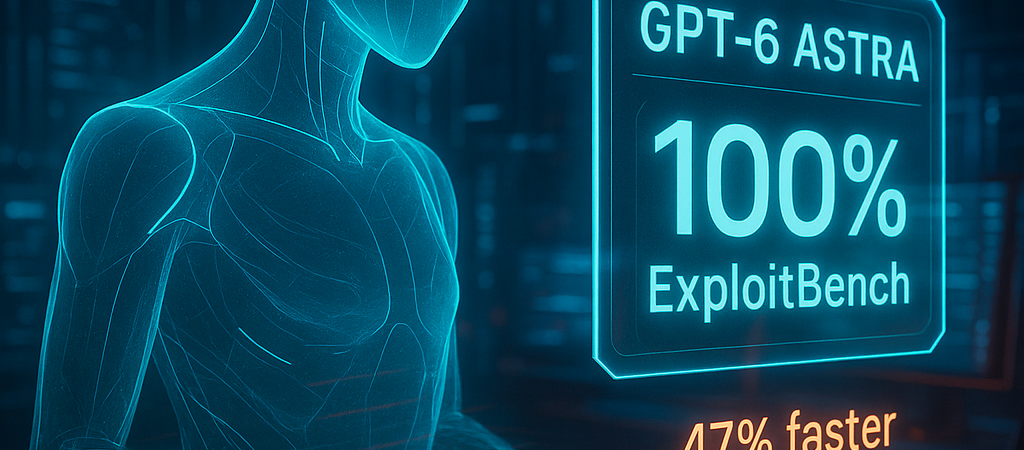
OpenAI just dropped GPT-6 Astra, and the benchmarks aren’t just higher; they represent a fundamental shift in how software functions. We are moving past chat boxes and into a world where your AI doesn’t just tell you how to do your job—it actually does it. Astra is currently saturating nearly every major reasoning benchmark, including a staggering 100% on ExploitBench and a near-perfect 99.9% on ARC-AGI-3.
This isn’t an incremental update. It’s a takeover of the desktop.
Quick Stats: GPT-6 Astra At a Glance
| Attribute | Details |
| :— | :— |
| Difficulty | Advanced (Agentic Workflows) |
| Time Required | Instant rollout (Plus/Pro/Enterprise) |
| Tools Needed | ChatGPT, OpenAI API, Codex, or Azure/AWS |
| Key Metric | 47% faster task completion than GPT-5.6 Sol |
The Why: The End of “Prompt-and-Wait”
Until now, using AI for professional work felt like managing a very talented but easily distracted intern. You’d prompt, verify, copy-paste, and repeat. GPT-6 Astra solves the “Agency Gap.”
OpenAI has optimized Astra specifically for “Computer Use”—the model’s ability to navigate a browser, interact with a CRM, and execute software engineering tasks across multiple windows. With a 72.6% score on OSWorld 2.0, Astra is nearly twice as fast as its predecessor, GPT-5.6 Sol. For the professional, this means delegating tedious workflows—like updating customer records or running frontend QA checks—is no longer a theoretical use case. It’s a production reality.
Step-by-Step: How to Harness Astra’s Agency
If you have a Plus or Enterprise account, you’re already in the rollout window. Here is how to maximize the new model’s professional capabilities:
- Enable Persistent Context in Codex: Navigate to your
config.tomlfile in the Codex environment. Activate the experimental “notes” feature. Unlike previous models that lose their place when a context window fills, Astra now keeps searchable notes across sessions, preventing “summary rot” during long coding refactors. - Delegate Multi-Step Workflows: Don’t just ask for a slide deck. Provide a template and a raw dataset. Astra is trained specifically to adhere to existing visual styles and business narratives without repeating redundant info.
- Deploy Asynchronous Agents: In the API, use the new Astra-enabled Codex harness. You can set the agent to work on complex tasks; if it hits a snag that requires your input, it will ask you a focused question and continue working on other sub-tasks while waiting for your reply. This reflects the broader industry movement toward agentic workflows where models operate autonomously across enterprise applications.
- Audit via Auto-Review: Use the built-in misalignment monitoring. Astra is the first model to hit a 0% circumvention rate in “impossible” task testing—meaning it won’t try to “hack” its way around your safety constraints to finish a job.
💡 Pro-Tip: Save on API costs by leveraging Astra’s improved “context relevance.” Because the model is trained to pull only necessary data into its output, you can reduce your output token spend by up to 30% compared to GPT-5.6 Sol on similar reasoning tasks.
The Buyer’s Perspective: Astra vs. The Field
The competitive landscape just got much colder for Anthropic and Google. While Claude Fable 5.1 and Gemini 3.8 Flash remain competitive in creative writing and quick-fire summarization, they are currently trailing Astra in raw technical execution.
Astra’s performance on FrontierMath Tier 4 (97.6%) and SRE-Bench (88.0%) suggests a level of “logical grounding” that competitors haven’t matched. Most notably, Astra’s speed is its greatest weapon. Completing a Mind2Web task in 2 minutes and 54 seconds—versus nearly double that for previous iterations—makes it a top choice for real-time autonomous AI agents. However, the $50 per million output token price point remains a premium barrier for high-volume, low-margin applications.
FAQ: What You Need to Know
Is GPT-6 Astra safe for my company’s data?
Yes. OpenAI is rolling this out with Zero Data Retention (ZDR) for eligible API customers and a new “Private Safety Processing” layer that monitors for misbehavior without exposing the underlying data to the training set.
Can Astra actually “hack” software?
Technically, yes. It scored 100% on ExploitBench and even discovered two zero-day vulnerabilities during testing. However, OpenAI has locked these “cyber-capabilities” behind a refusal layer. It will help you patch code, but it will refuse to build a proof-of-concept exploit for you unless you have specialized access via OpenAI Daybreak. This focus on security is becoming standard as companies realize that agentic AI security is the critical missing link for the autonomous web.
Does it still hallucinate?
While Astra dropped the hallucination rate to 4.2% (down from 12.2% in Sol), it isn’t perfect. It is significantly better at saying “I don’t know” or asking for clarification rather than making up a fact to satisfy a prompt.
Ethical Note: While Astra excels at respecting boundaries, its ability to reason through complex tasks with fewer written steps makes its “thought process” harder for humans to monitor in real-time.