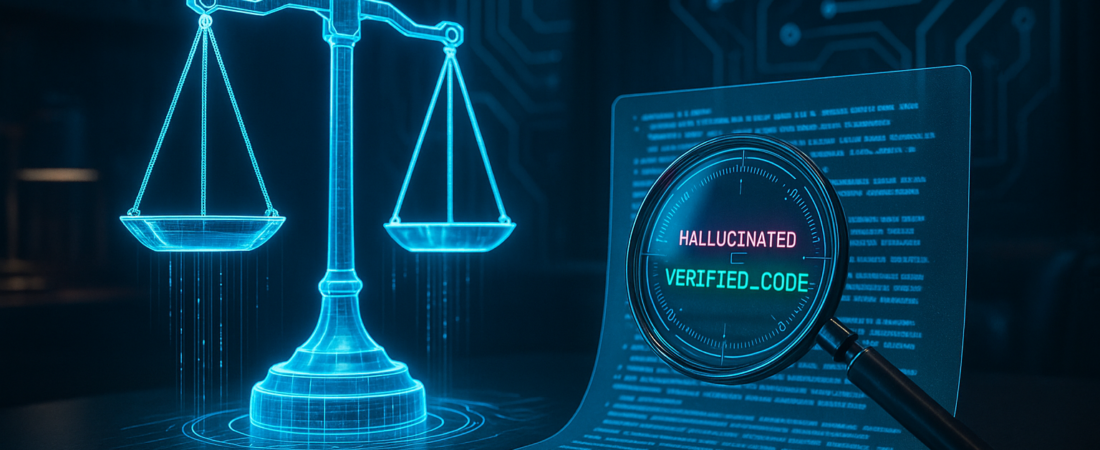
Lawyers are currently walking through a minefield of their own making. Since ChatGPT went mainstream, courts have been flooded with legal briefs citing cases that don’t exist, written by an AI that would rather lie to your face than admit it doesn’t know a citation. It’s no longer a freak occurrence; it’s a systemic risk that has already led to sanctions for partners at reputable firms and scathing rebukes from federal judges.
The era of “blind trust” in AI drafts is dead. A new wave of verification tools is emerging to act as a digital filter, catching the AI’s creative fictions before a judge does. As the market shifts, many enterprise AI strategy shifts are moving toward platform lock-in and infrastructure that prioritizes accuracy over mere speed.
| Attribute | Details |
| :— | :— |
| Difficulty | Intermediate (Requires tech integration) |
| Time Required | 5–15 minutes per filing |
| Tools Needed | CiteSentinel, Clearbrief, CiteCheck AI, LexisNexis/Westlaw |
The Why: The 88% Failure Rate
We are past the point of “testing the waters.” Stanford researchers recently discovered that general-purpose AI tools can hallucinate up to 88% of the time when tasked with specific legal queries. Even specialized legal models fail roughly 17% of the time.
For a busy attorney, those odds are a professional death wish. The problem stems from the nature of Large Language Models (LLMs). They are pattern-matchers, not fact-checkers. They prioritize “eloquence” and “truthiness”—sounding right rather than being right. If an AI can’t find a case that supports your argument, it will simply synthesize one that sounds like it should exist. You aren’t just paying for speed; you’re paying for a liability that requires a new kind of insurance: deterministic verification. To combat this, some firms are turning to an AI Knowledge Hub to connect their generative tools to a single source of truth and eliminate hallucinations.
How to Bulletproof Your Briefs
If you are using generative AI to draft or edit, you must treat every citation as a potential lie. Here is how to implement a modern verification workflow.
- Isolate the AI’s Role: Use generative AI for structural drafting or brainstorming, but never for the final citation pull. Keep your research (Westlaw/Lexis) and your drafting (AI) in separate silos until the final assembly.
- Deploy Deterministic Filters: Upload your draft to a tool like CiteSentinel or CiteCheck AI. These tools don’t “guess”—they cross-reference every citation against live legal databases to ensure the case name, volume, and page number actually exist.
- Audit the “Record” Facts: Hallucinations aren’t limited to fake cases. AI often misrepresents the facts of the trial record. Tools like Clearbrief allow you to view the source document (like a deposition transcript) side-by-side with your draft to ensure the AI hasn’t “drifted” from the truth.
- Run an “Opposing Counsel” Scan: Don’t just check your own work. Use these tools to scan incoming filings from the other side. Catching a hallucinated citation in an opponent’s brief is the ultimate procedural leverage.
- Final Human Verification: Never submit a document that hasn’t been read line-by-line by a human who understands the nuances of the law. This is a critical component of a professional AI-First Workflow where human oversight remains the final safeguard.
💡 Pro-Tip: When prompting an AI to summarize a case, ask it to provide the specific paragraph number for every claim it makes. If the AI hesitates or provides a range that doesn’t exist, you’ve caught a hallucination in the making.
The “Buyer’s Perspective”: Specialized vs. General Tools
The market is currently split between two philosophies.
CiteSentinel and CiteCheck AI are the “Rapid Response” tools. They are designed for the lawyer who wants a quick, final check before hitting “file.” They are lightweight, efficient, and focus almost exclusively on the existence of citations.
Clearbrief, on the other hand, is a deep-integration workflow tool. It is built for litigators who need to ensure that every claim—legal or factual—is grounded in the evidence. While more expensive and requiring a steeper learning curve, it offers a “deterministic” approach (rule-based logic) that significantly outperforms the “probabilistic” (guess-based) logic of standard AI. For those using Microsoft products, the new AI Legal Agent for Word is beginning to automate contract redlines and complex revisions directly within the document editor.
If you are a solo practitioner, a quick scan tool is your best ROI. If you are in a high-stakes litigation firm, you need a tool that handles the entire evidence ecosystem. This transition is part of a larger agentic AI shift aimed at automating the in-house backlog and legal intake processes.
FAQ
Q: Can’t I just ask ChatGPT if the case is real?
A: No. If the AI lied the first time, it will often lie to cover its tracks, a phenomenon known as “hallucination stacking.” Always use a third-party, non-generative tool for verification.
Q: Are these tools ethical to use?
A: Yes, and in many jurisdictions, using verification technology is becoming the new standard of care. The unethical act is submitting unverified, machine-generated content to the court. Many firms are now adopting AI text detection tools as a way to manage liability protection and ensure content integrity.
Q: Do these tools work for state and local courts?
A: Most top-tier tools integrate with major legal databases that cover federal, state, and appellate courts, but you should always verify the database coverage for your specific jurisdiction before relying on them.
Ethical Note: While these tools catch errors, they cannot replace the strategic judgment of a lawyer; they are filters for accuracy, not substitutes for legal reasoning. Professionals must stay updated on the latest AI legal analysis trends to understand how these tools are disrupting data giants and changing the courtroom landscape.