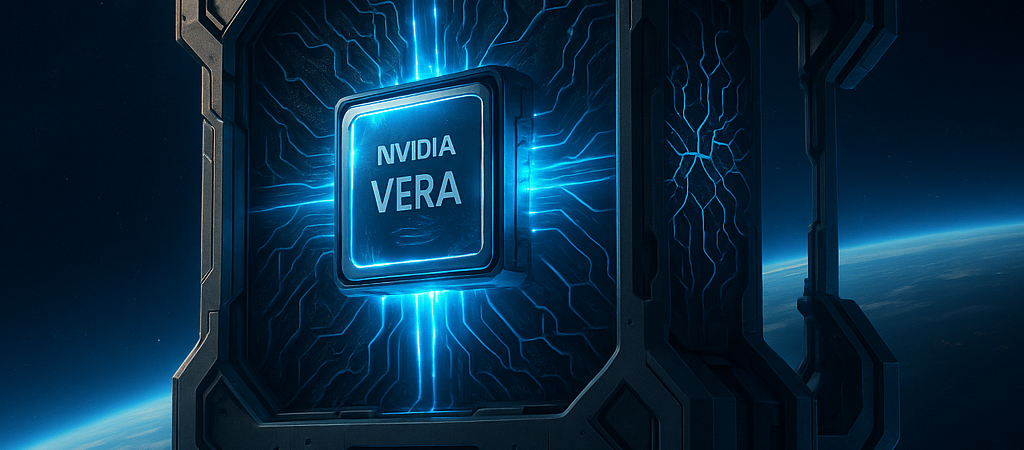
SpaceXAI isn’t just building smarter chatbots; they are building an orbital brain. By adopting NVIDIA’s new Vera CPU architecture, the company is signaling that the next phase of AI isn’t about just generating text—it’s about autonomous agents that can code, reason, and act in real-time, whether they are in a Texas data center or a satellite orbiting Earth.
| Attribute | Details |
| :— | :— |
| Difficulty | Advanced (Enterprise Infrastructure) |
| Key Tech | NVIDIA Vera CPU, Rubin Platform, NVL72 |
| Core Goal | Accelerating Agentic AI & Orbital Computing |
| Impact | 1.8x faster task completion vs. x86 |
The Why: The “CPU Bottleneck” in the Age of Agents
For years, the industry narrative focused almost exclusively on GPUs. If you wanted more AI power, you bought more H100s. But “Agentic AI”—AI that doesn’t just talk but actually does things—has a different hunger. When an AI agent needs to browse the web, execute a Python script to verify data, or orchestrate complex workflows between different models, it hits a wall known as the CPU bottleneck.
Standard x86 processors, designed for general-purpose computing, struggle to keep up with the rapid-fire “thought-to-action” cycles of high-speed agents. SpaceXAI’s adoption of the Vera CPU solves this by treating the CPU not just as a support player, but as a dedicated orchestrator. This move ensures that while the GPUs handle the heavy math, the Vera CPUs handle the logic, preventing expensive silicon from sitting idle while waiting for data. This shift is part of a broader industry transition where Agentic AI is redefining the 2026 workforce by moving beyond simple chat interfaces to autonomous execution.
The Strategy: Implementing the Vera Rubin Architecture
SpaceXAI is deploying this hardware across two distinct frontiers. Here is how they are structuring this massive scale-up:
-
Build the Terrestrial Foundation
SpaceXAI is integrating the NVIDIA Vera Rubin platform into its ground-based AI factories. This involves syncing Vera CPUs with Rubin GPUs via NVLink, creating a unified memory pool that allows agents to access data at 1.2TB/s. This infrastructure is essential because ASIC-first inference clouds are beginning to take over the agent economy, reducing costs and latency compared to traditional setups. -
Optimize for “Agentic” Logic
Unlike traditional training, SpaceXAI is tuning these systems for reinforcement learning and tool-use. They are leveraging Vera’s 88 “Olympus” cores to run simulations in parallel, allowing Grok to test hypotheses in digital sandboxes before delivering an answer. -
Launch the Orbital Node (Starmind)
The final step is the most ambitious: miniaturizing the NVL72 rack-scale system for the Starmind AI satellite. This involves adapting the high-bandwidth architecture to survive the thermal and power constraints of space, effectively putting a supercomputer in low Earth orbit. This represents a significant leap in orbital computing capabilities, allowing for real-time data processing far beyond the terrestrial cloud.
💡 Pro-Tip: For developers working on agentic workflows today, the lesson from SpaceXAI is “Context Management.” You can simulate Vera-like performance gains by optimizing your data preprocessing on the CPU side before it ever hits the GPU, reducing latent “wait time” in your agent loops.
The Buyer’s Perspective: Why Vera Over x86?
NVIDIA is making a bold claim: the era of the general-purpose CPU in the data center is ending. By designing the Vera CPU specifically for AI agents, they are directly challenging Intel and AMD’s dominance in the server rack.
From an architectural standpoint, Vera’s 1.8x performance boost in task completion isn’t just a marginal gain; it’s a total cost of ownership (TCO) play. If SpaceXAI can get “more useful work from every watt,” as Mike Nicolls suggests, they can scale Grok’s capabilities to gigawatt levels without the power bill spiraling out of control. The competition—primarily x86-based clusters—will likely struggle with the latency overhead required for real-time autonomous reasoning. This efficiency is critical as the industry moves toward AI-native 6G networks, turning static towers into intelligent cloud software.
However, the risk lies in the ecosystem lock-in. Adopting Vera means fully committing to the NVIDIA vertical stack (Spectrum-X, BlueField, NVLink). For a company like SpaceXAI, the speed is worth the price of entry; for smaller players, the cost of switching away from industry-standard x86 might be a steeper hill to climb.
FAQ
What exactly is “Agentic AI”?
It refers to AI systems designed to achieve goals autonomously by using tools, executing code, and making multi-step decisions, rather than just predicting the next word in a sentence.
How does a CPU “accelerate” AI if the GPU does the heavy lifting?
In agentic workflows, the CPU handles “orchestration”—it decides which tool to use, processes the input data, and manages the logic flow. If the CPU is slow, the GPU stays idle, wasting power and time.
Why put AI satellites in space?
Orbital AI (like Starmind) allows for real-time data processing at the source—such as analyzing satellite imagery or managing communication networks—without the latency of sending massive raw datasets back down to Earth for processing.
Ethical Note/Limitation: While Vera accelerates the logic of AI agents, it does not inherently solve the problem of “agentic drift,” where autonomous systems may execute unintended actions if their reward functions are poorly defined. To mitigate these risks, organizations are increasingly looking toward an Agentic Kill Switch as a vital safety layer for autonomous operations.