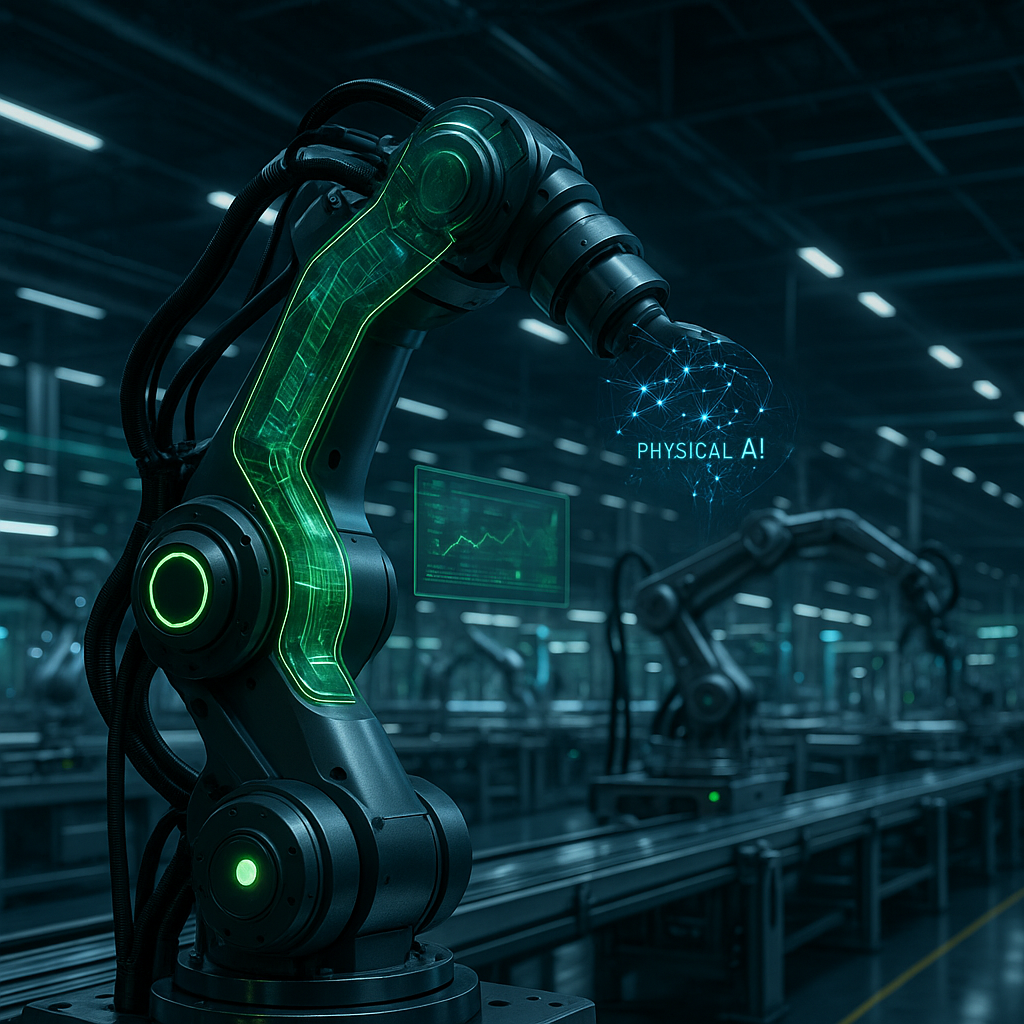
Germany isn’t just looking to catch up in the AI race; it’s looking to move the finish line. While Silicon Valley obsesses over chatbots and art generators, Berlin is betting the house on “Physical AI”—the marriage of neural networks with the heavy machinery that powers the global economy.
At a recent summit in a former Berlin power station, NVIDIA CEO Jensen Huang and German Chancellor Friedrich Merz signaled a shift in global tech dynamics. Germany is opening its factory doors to NVIDIA’s silicon to ensure the Mittelstand—the country’s legendary small-to-medium manufacturing backbone—doesn’t become a digital relic.
Quick Stats: The Industrial AI Shift
| Attribute | Details |
| :— | :— |
| Strategic Focus | Physical AI & Digital Twins |
| Key Players | NVIDIA, Siemens, German Federal Gov |
| Investment Scale | $10B commitment by NVIDIA across Europe |
| Primary Goal | 85% reduction in engineering effort via virtual ramp-up |
| Implementation | Industry 4.0 Platform integration |
The Why: Beyond the Chatbot
The world is tired of AI that just writes emails. The real economic frontier is AI that moves atoms. Germany’s economy thrives on high-end engineering, but traditional manufacturing is slow, expensive, and rigid. By integrating NVIDIA’s AI stack, German firms can simulate entire factories in “digital twins” before a single bolt is turned.
This solves the “dead data” problem. Most manufacturers sit on mountains of operational data they never use. Merz is effectively ordering the Mittelstand to “open your doors” to AI, turning that stagnant data into autonomous workflows. If they succeed, Germany becomes the global blueprint for the autonomous factory. To understand how other sectors are making this transition, look at how PTC brings generative AI to the factory floor to turn PLM data into actionable insights.
Step-by-Step: How to Modernize Using the German Blueprint
You don’t need a billion-euro budget to adopt the strategies discussed by Huang and Merz. Here is how to implement an industrial AI mindset:
- Audit Your Physical Data: Identify where your “analog” bottlenecks exist. Before buying GPUs, catalog the sensor data, CAD files, and logistical logs your company already generates.
- Deploy Digital Twins: Use platforms like NVIDIA Omniverse or Siemens’ industrial software to create a virtual mirror of your production line. This allows for “risk-free” experimentation.
- Simulate Before You Build: Run synthetic stress tests on your virtual model. Siemens recently proved that virtual production ramp-ups can slash engineering effort by 85%.
- Integrate Agentic Planning: Move away from rigid, linear coding. Implement AI agents that can re-route production tasks in real-time when a machine fails or a supply chain breaks. Many companies are now exploring how autonomous agents use real-time predictive maintenance to manage heavy assets without human intervention.
- Scale via the Ecosystem: Don’t build bespoke models from scratch. Leverage the “Industry 4.0” frameworks and joint initiatives coming out of the NVIDIA-Germany partnership to use pre-trained physical AI models.
💡 Pro-Tip: Focus on “Synthetic Data Generation.” One of the biggest hurdles in industrial AI is a lack of failure data (since you don’t want your machines to actually break). Use your digital twin to simulate thousands of “crashes” to train your AI on how to avoid them in the real world.
The “Buyer’s Perspective”: Silicon vs. Steel
For decades, Germany provided the steel and NVIDIA provided the pixels for gamers. This new alliance flips the script. By investing $10 billion into European startups like Agile Robots and Reflex Aerospace, NVIDIA is positioning itself as the operating system for the physical world. This is part of a broader trend where NVIDIA is turning the airwaves into software through AI-native 6G networks to ensure zero-latency connectivity for these industrial hubs.
Compared to competitors like Microsoft or Google—who are heavily focused on the “cloud” and “office” productivity—NVIDIA is moving into the “dirt and grease” of manufacturing. For a business leader, the value proposition is clear: if you operate in the physical realm, NVIDIA’s focus on low-latency, high-fidelity simulation (Omniverse) is currently unmatched by standard LLM providers. However, the barrier to entry remains high; it requires significant hardware investment and a workforce that understands both mechanical engineering and data science.
FAQ: What You Need to Know
Is Industrial AI just another word for automation?
No. Traditional automation follows a “if-this-then-that” script. Industrial AI uses “Physical AI” to perceive, reason, and adapt to changing environments without a human rewriting the code.
Will this replace the German Mittelstand workers?
Jensen Huang argues no. He views AI as an “augmenting instrument.” The goal is to take the institutional knowledge of a master machinist and scale it through an AI model, not fire the machinist.
Why is Siemens involved?
Siemens is the bridge. They own the factory floor software. By partnering with NVIDIA, they are putting AI directly into the tools that manage global supply chains and power grids.
The Reality Check
Despite the optimism, Physical AI still struggles with “sim-to-real” gaps—where a robot performs perfectly in a digital simulation but fails in the messy, unpredictable environment of a real-world factory floor. We are still years away from a completely “lights-out” autonomous economy.