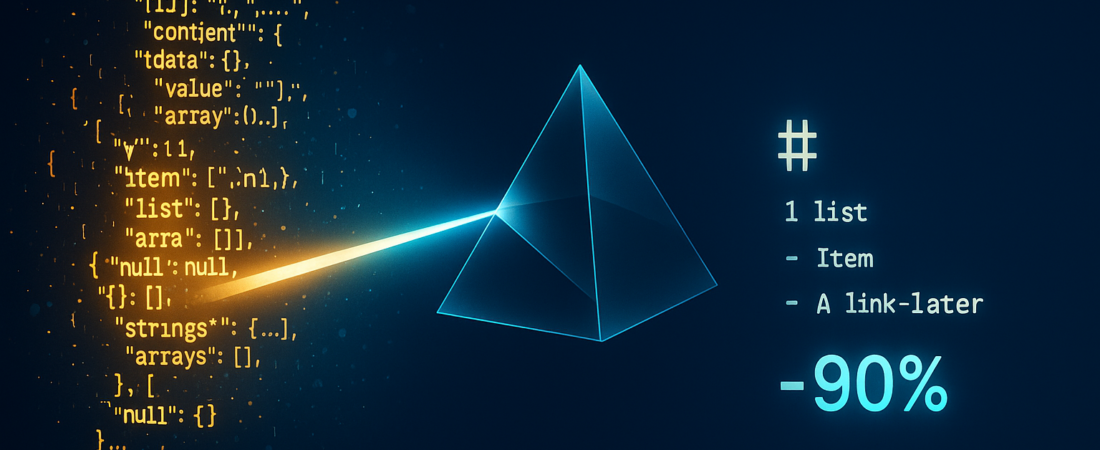
Every token you feed an LLM is a choice between intelligence and overhead. For years, developers building AI agents have been forced to pay a “JSON tax”—shoveling bloated, bracket-heavy code into context windows just to give a model a few snippets of search data.
SerpApi just deleted that tax. With the launch of their new Markdown output, the industry leader in search data extraction is claiming a reduction in token consumption of up to 90%. In a world where context windows are the most expensive real estate in tech, this isn’t just a minor update; it’s a structural shift in how we ground AI in reality.
| Attribute | Details |
| :— | :— |
| Difficulty | Intermediate (Requires API experience) |
| Time Required | 5–10 minutes to implement |
| Tools Needed | SerpApi Account, Python/Node.js, any LLM (GPT-4o, Claude 3.5) |
The Why: The High Cost of Clutter
Large Language Models (LLMs) don’t think in code; they reason through patterns. When you send a standard JSON response from a search engine—complete with nested objects, curly braces, and redundant metadata—the model has to work twice as hard. It spends precious tokens “reading” the structure rather than the content.
This creates three specific bottlenecks:
- Cost: More tokens equals higher bills from OpenAI or Anthropic.
- Latency: Larger inputs take longer for the model to process.
- Hallucination: When a context window is cluttered with irrelevant JSON noise, the “signal” (the actual search results) gets lost, increasing the risk of the model losing the plot.
By switching to Markdown, SerpApi provides the data in the format LLMs were literally trained to prioritize. It’s cleaner, human-readable, and drastically more dense. This efficiency is a core part of a modern AI-First Workflow that prioritizes speed and accuracy.
Step-by-Step: Moving from JSON to Markdown
You don’t need to rewrite your entire codebase to take advantage of this. SerpApi built this to be a plug-and-play optimization.
- Authenticate your request. Use your existing SerpApi key. No new tier or “AI-specific” plan is required to access the feature.
- Append the output parameter. Add
output=markdownto your API request. If you’re using a specific library (like the SerpApi Python gem), you can pass this as a standard parameter in your search dictionary. - Specify your engine. Whether you are scraping Google Search, Bing, or specialized engines like Google Scholar, the Markdown toggle works globally across all 100+ SerpApi endpoints.
- Inject directly into the Prompt. Take the raw string returned by the API and drop it into your System Message or User Prompt under a header like
## Search Results. - Monitor token usage. Compare the
usagestats from your LLM provider before and after the switch. Most users see an immediate 50% drop in input tokens. By reducing this “token tax,” developers can build more adaptive AI agents that focus on learning rather than redundant data processing.
💡 Pro-Tip: If you are building an autonomous agent that needs to cite its sources, Markdown is vastly superior. LLMs can easily parse Markdown links [Title](URL) to generate footnotes, whereas extracting URLs from a complex JSON tree often requires additional “Reasoning” steps that burn even more tokens.
The Buyer’s Perspective: Is it Worth the Switch?
If you’re a hobbyist running ten searches a day, the token savings might be pennies. But for enterprise-grade agentic workflows—think automated market research bots or real-time news aggregators—the math is undeniable.
SerpApi’s main competitors, like Bright Data or ZenRows, often focus on the raw extraction of HTML or massive JSON blobs. While powerful, they put the burden of “cleaning” the data on the developer. SerpApi is pivoting toward being an AI infrastructure company rather than just a scraping tool. By doing the pre-processing (converting raw web data into LLM-optimized Markdown) on their servers, they save you the compute costs of doing it on yours. This shift toward smarter infrastructure is similar to how companies are moving toward a Universal AI Platform to handle complex model management and data flows.
The downside? If your application relies on highly specific metadata hidden in deep JSON nesting (like specific X/Y coordinates of a search element), Markdown might strip too much away. It is a tool for reasoning, not for pixel-perfect data mapping.
FAQ
Does this cost more per SerpApi request?
No. Markdown output is included in all existing plans at no extra cost. The savings happen on your LLM provider’s side (OpenAI/Anthropic), not SerpApi’s billing.
Can I still get JSON if I need it?
Yes. The feature is request-based. You can fetch JSON for your backend database and Markdown for your LLM within the same application by changing a single parameter.
Which search engines support this?
All of them. SerpApi has standardized the Markdown output across their entire suite, from Google Search to YouTube and Walmart.
Ethical Note/Limitation: While Markdown reduces token usage, it does not solve the inherent bias of search engine algorithms; your AI is still only as objective as the search results it receives.