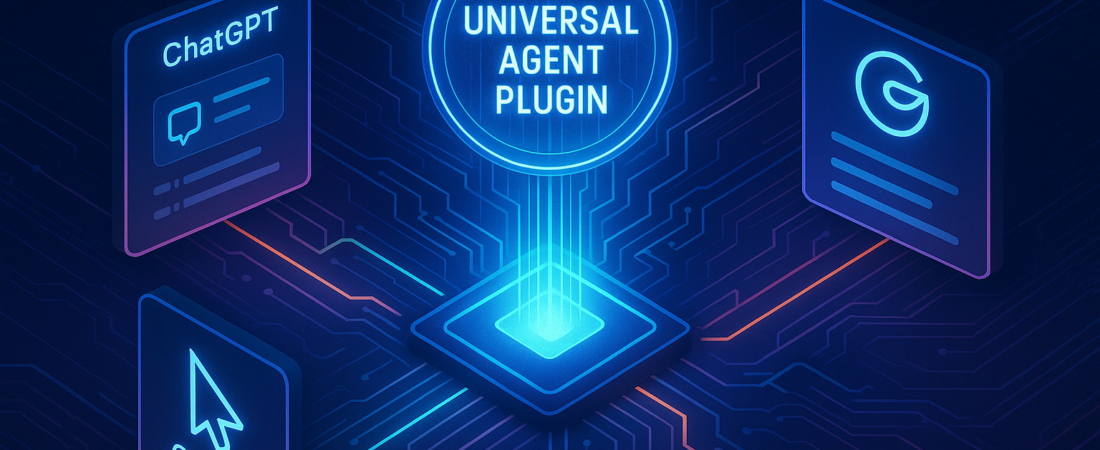
The era of rebuilding the same AI tool for five different platforms is officially over. OpenAI just dropped a bomb on the developer ecosystem: a universal “Agent Plugin” standard created in partnership with industry titans like GitHub, Vercel, and Cursor. Even Google has signed on as a maintainer. This isn’t just another technical spec; it’s a peace treaty in the AI arms race that finally prioritizes the people actually building the tech.
| Attribute | Details |
| :— | :— |
| Difficulty | Intermediate (Requires API knowledge) |
| Time Required | 15–30 minutes for initial configuration |
| Tools Needed | OpenAI SDK, GitHub, Vercel, or MCP-compatible servers |
The Why: One Build to Rule Them All
Until today, if you built an “Agent Skill”—say, a tool that lets an AI browse your company’s private documentation or execute code—you were likely locked into a specific ecosystem. You built for ChatGPT, or you built for Claude, or you built for a niche IDE.
This fragmentation created a massive tax on innovation. Developers spent more time “wrapping” their logic for different chat interfaces than they did improving the logic itself. By introducing an open standard that supports Model Context Protocol (MCP) server configurations, OpenAI and its partners are effectively creating a “USB port” for AI agents. Build the plugin once, and it works across Cursor, VS Code, Gemini Enterprise, and ChatGPT.
For the professional, this means your custom workflows are no longer hostages to a single provider. For instance, companies are already using the Model Context Protocol to eliminate data blindness by connecting agents directly to unstructured internal data. If Gemini offers better reasoning for a specific task but your tools are stuck in OpenAI, the friction is now gone.
Step-by-Step Instructions: Implementing the New Standard
The shift toward a unified format means you can now package Agent Skills into a shared format that any compatible client can digest. Here is how to get started with the new interoperable framework.
- Define your Skill Logic: Write your core function in a clean, modular environment. Ensure your tool performs a single, discrete task—like fetching weather data, querying a SQL database, or interacting with a specific API.
- Adopt the Open Standard Manifest: Instead of a proprietary JSON file, use the new open plugin schema. This manifest tells the agent what your tool does, what parameters it requires, and how to handle the output.
- Configure your MCP Server: Leverage the Model Context Protocol (MCP). If you are using GitHub or Vercel to host your logic, ensure your server is configured to broadcast its capabilities in the shared format. This is similar to how a Google MCP server bridges the gap between local development tools and powerful cloud infrastructure.
- Connect to Multiple Clients: Point your Agent Plugin URL toward your IDE (like Cursor) and your enterprise chat interface (like Gemini or ChatGPT).
- Validate Permission Scopes: Use the standardized OAuth or API key headers defined in the new spec to ensure that when your agent moves between platforms, your security credentials follow securely.
💡 Pro-Tip: Don’t manually write your manifest files. Use the Cursor IDE with this new standard enabled; it can auto-generate the plugin configuration by “reading” your function code, saving you from tedious syntax errors in the JSON schema. This level of automation is part of why many believe Cursor Composer 0.2 and similar tools are ending the era of manual coding labor.
The Buyer’s Perspective: Interoperability is the New Alpha
In the software world, “open” usually wins in the long run. By partnering with GitHub, Vercel, and AWS, OpenAI is signaling that they want to be the infrastructure, not just the interface.
The Competition:
- Anthropic: While Claude is a fan favorite for coding, Anthropic currently maintains its own Claude-specific standards. However, with Google (a major Anthropic investor) joining the OpenAI-led standard as a maintainer, expect Anthropic to eventually fold into this ecosystem or risk isolation.
- Google Gemini: Google’s commitment to being a maintainer is the most surprising and significant part of this news. It suggests that Gemini Enterprise will soon be a “drop-in” replacement for ChatGPT for power users who have already built extensive plugin libraries.
The value proposition is simple: Reduced Technical Debt. Choosing a standard supported by both Microsoft (via GitHub/OpenAI) and Google is the safest bet a CTO can make in 2026. You are no longer betting on a horse; you are betting on the track.
FAQ
Q: Does this mean ChatGPT plugins are back?
A: Not exactly. The old “ChatGPT Plugins” were a closed system. These are “Agent Plugins”—a more robust, developer-centric standard designed for autonomous agents that can work across different apps and IDEs.
Q: Do I need to pay for a premium subscription to use this?
A: While the standard is open, the clients that use them (like Gemini Enterprise or ChatGPT Plus) will likely require their respective subscriptions. However, building and hosting the plugins is now model-agnostic.
Q: What is the relationship between this and MCP?
A: This standard supports MCP (Model Context Protocol) server configurations. Think of MCP as the language and the Agent Plugin standard as the envelope it’s delivered in. They work together to make sure the AI knows exactly what your tool can do. Organizations like Otter.ai are already adopting MCP to transform their platforms into interconnected enterprise search engines.
Ethical Note/Limitation: While this standard streamlines how tools connect to AI, it does not solve the “hallucination” problem; an agent can still incorrectly invoke a tool or provide it with the wrong arguments if the prompt is ambiguous.
New Internal Linking URLs Added:
- https://jsnmarketing.com/model-context-protocol-sales-ai
- https://jsnmarketing.com/google-mcp-server-gemini-enterprise
- https://jsnmarketing.com/cursor-composer-02-ai-coding-guide
- https://jsnmarketing.com/google-gemini-enterprise-agent-platform-guide
- https://jsnmarketing.com/otter-ai-mcp-enterprise-search